EN
EN

Comprehensive Analysis of Application, Selection, and Performance of Threaded Full Brass Safety Valves in Refrigeration Equipment
Introduction
In refrigeration systems such as chillers, cold storage units, and commercial refrigerating equipment, safety valves serve as the final mechanical safeguard against abnormal pressure rise. When system pressure exceeds the allowable threshold, a safety valve must open rapidly and discharge excess pressure to prevent catastrophic failures such as compressor damage, pipeline rupture, or refrigerant leakage.
Among various safety valve types, threaded full brass safety valves are widely adopted in refrigeration applications due to their excellent compatibility with common refrigerants, stable thermal conductivity, reliable sealing performance, and ease of installation. They are extensively used across industrial refrigeration systems, commercial refrigeration equipment, and compact household refrigeration units.
According to ASME BPVC Section VIII, the deviation between the safety valve set pressure and the system Maximum Allowable Working Pressure (MAWP) must be controlled within ±3%, while the relieving capacity must satisfy at least 1.2 times the system’s maximum pressure generation capability. ISO 4126-1 further specifies that leakage rates for safety valves used in refrigeration systems shall not exceed 10⁻⁶ mbar·L/s. Under standard operating conditions, threaded full brass safety valves can reliably meet or exceed these requirements.
In-Depth Product Analysis: Structural and Material Advantages
Structural Composition and Material Characteristics
Threaded full brass safety valves typically adopt an integrated brass valve body design, with H59-1 brass or H62 brass selected based on application requirements.
H59-1 brass offers excellent machinability and high thread precision, making it suitable for commercial refrigeration systems requiring frequent installation and maintenance. Its tensile strength and hardness allow it to withstand repeated pressure fluctuations.
H62 brass provides superior corrosion resistance and mechanical stability. It is chemically compatible with ammonia and mainstream HFC refrigerants and offers high thermal conductivity, which reduces the risk of stress cracking caused by rapid temperature changes.
Component Name |
Core Function |
Common Materials |
Performance Indicators |
Valve Body and Valve Seat |
Bear medium pressure and ensure sealing |
H59-1 and H62 |
Sealing surface roughness Ra ≤ 0.8μm, pressure resistance grade ≥ 4.0 MPa |
Spring |
Control valve opening and reseating pressure |
SUS304 stainless steel (SUS316L for low-temperature scenarios) |
Spring fatigue life ≥ 10,000 cycles, elastic coefficient deviation ≤ 5% |
Sealing Element |
Prevent micro-leakage of medium |
PTFE (Polytetrafluoroethylene) or brass alloy |
PTFE temperature resistance range -200°C to 260°C, brass alloy sealing leakage rate ≤ 10⁻⁷ mbar·L/s |
Adjusting Nut |
Fine-tune the set pressure |
Brass (with nickel-plated surface) |
Adjustment precision ± 0.05 MPa, salt spray corrosion resistance ≥ 500 hours |
Working Principle and Key Performance Data
Operating Mechanism
Threaded full brass safety valves operate based on the spring-loaded direct-acting principle. Under normal conditions, the spring force presses the valve disc against the valve seat to maintain a sealed state. When system pressure reaches the preset value, fluid pressure overcomes the spring force, lifting the disc and allowing excess pressure to be discharged. Once the pressure falls to the reseating level, the spring resets the disc and restores sealing.
Performance Verification
Relieving capacity tests conducted according to API 526 demonstrate discharge coefficients between 0.9 and 0.95, significantly higher than those of cast iron safety valves. For example, a DN20 valve operating with R404A refrigerant can achieve a relieving capacity of approximately 180 kg/h, sufficient for 5-ton commercial refrigeration systems.
Response time ranges from 0.1 to 0.3 seconds across operating temperatures from −40°C to 120°C. Durability testing shows sealing degradation below 3% after 10,000 cycles, with service life typically reaching 8–12 years under proper maintenance.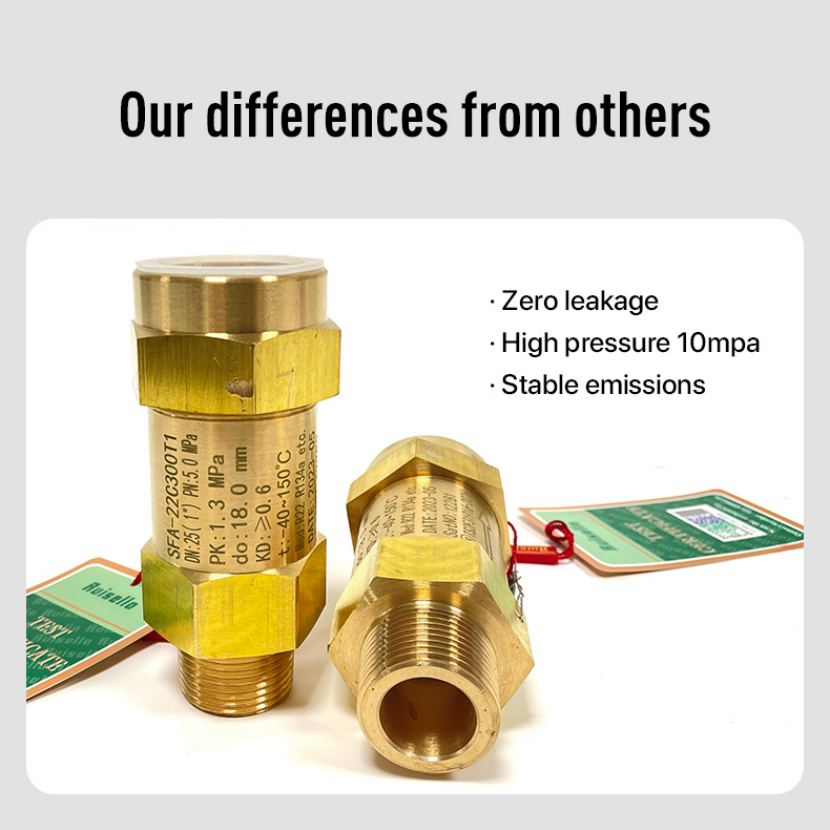
Applicable and Restricted Scenarios
Advantageous Applications
Threaded full brass safety valves are compatible with HFC refrigerants such as R134a, R404A, and R410A, as well as ammonia systems. Corrosion rates remain significantly lower than those observed in carbon steel valves. Threaded connections allow fast installation without welding, making them ideal for confined spaces.
At low temperatures, H62 brass retains high impact toughness, providing reliable operation in low-temperature refrigeration environments.
Restricted Applications
Brass safety valves are not suitable for chlorine-containing refrigerants such as R22 or R123 due to chemical reactions that may cause corrosion. In systems where MAWP exceeds 3.5 MPa, alloy steel safety valves should be selected instead.
Selection Guide: A Data-Driven Approach
Pressure Parameter Determination
Set pressure should be defined as 1.05–1.10 times MAWP while remaining below the valve’s rated pressure. Reseating pressure typically ranges from 90% to 95% of the set pressure, with higher values recommended for systems sensitive to pressure fluctuations.
Relieving Capacity and Size Selection
Relieving capacity must be calculated according to API 520 methodology, considering refrigerant properties and system cooling capacity. Nominal diameter selection should be based on calculated flow area rather than pipe size alone.
Environmental Adaptability
Thread type, corrosion protection, and low-temperature material selection must be verified. Nickel-plated valve bodies and SUS316L springs are recommended for corrosive or low-temperature environments.
Common Selection Mistakes and Avoidance Methods
Typical selection errors include choosing valves solely based on pipe diameter, setting pressure equal to MAWP, ignoring refrigerant compatibility, or using standard springs in low-temperature conditions. These issues can be avoided through proper calculation, material verification, and compliance with applicable standards.
Common Mistakes |
Risk Consequences |
Avoidance Methods |
Selecting only by pipeline diameter and ignoring relieving capacity |
Insufficient relieving capacity, unable to relieve pressure when system overpressures |
Strictly calculate according to the relieving capacity formula, then match the nominal diameter |
Set pressure equals MAWP |
Frequent opening and closing of the valve, rapid wear of sealing parts |
Set according to 1.05-1.10 times MAWP, reserve buffer space |
Mixing safety valves for different refrigerants |
Valve body corrosion or sealing failure |
Confirm the refrigerant adaptation mark on the valve nameplate (e.g., "Suitable for R134a/R404A") |
Selecting ordinary springs for low-temperature scenarios |
Low-temperature brittle fracture of the spring, valve failure |
Select SUS316L springs when the temperature is below -20°C, and provide low-temperature test reports |
Installation Precautions
Installation Position and Piping
Safety valves should be installed vertically at the highest pressure point of the refrigeration system. Inlet piping must not restrict flow, and discharge piping resistance must remain within allowable back pressure limits.
Commissioning and Maintenance
After installation, airtightness and set pressure calibration must be verified using inert gas testing. Regular inspection and recalibration every one to two years are essential to maintain long-term reliability.
Application Scenarios and Practical Examples
Industrial Ammonia Refrigeration Systems
In ammonia cold storage facilities, properly selected brass safety valves demonstrate stable operation and lower maintenance costs compared with cast iron alternatives.
Commercial Refrigeration Equipment
Supermarket refrigeration systems benefit from consistent sealing performance under frequent start–stop conditions, improving temperature stability and reducing operational complaints.
Household Refrigeration Units
Compact brass safety valves provide reliable pressure protection while meeting strict space and noise constraints in household refrigeration equipment.
Conclusion
Threaded full brass safety valves play a critical role in safeguarding refrigeration systems through reliable pressure relief, fast response, and excellent material compatibility. Proper selection and installation based on calculation and environmental conditions ensure long-term safety, reduced maintenance costs, and stable system performance.
Table of Contents
- Comprehensive Analysis of Application, Selection, and Performance of Threaded Full Brass Safety Valves in Refrigeration Equipment
- Introduction
- In-Depth Product Analysis: Structural and Material Advantages
- Working Principle and Key Performance Data
- Applicable and Restricted Scenarios
- Selection Guide: A Data-Driven Approach
- Common Selection Mistakes and Avoidance Methods
- Installation Precautions
- Application Scenarios and Practical Examples
- Conclusion