EN

01 | The Test That Hides the Problem
A DN50 Class 300 floating ball valve passes its shell test and its seat test at the specified multiple of the rating, is packed, shipped, installed, and then weeps on a transfer line running at 0.2 MPa. The valve is not defective. It was tested at a pressure it will never see in service, and the mechanism it relies on for sealing does not operate at the pressure it does see.
The hydro test loads a soft seat heavily and the valve seals easily. At 0.2 MPa the same seat carries almost no pressure assist, and everything depends on the preload built in at assembly. Nothing in a normal test sequence checks that condition unless the buyer asks for it specifically.
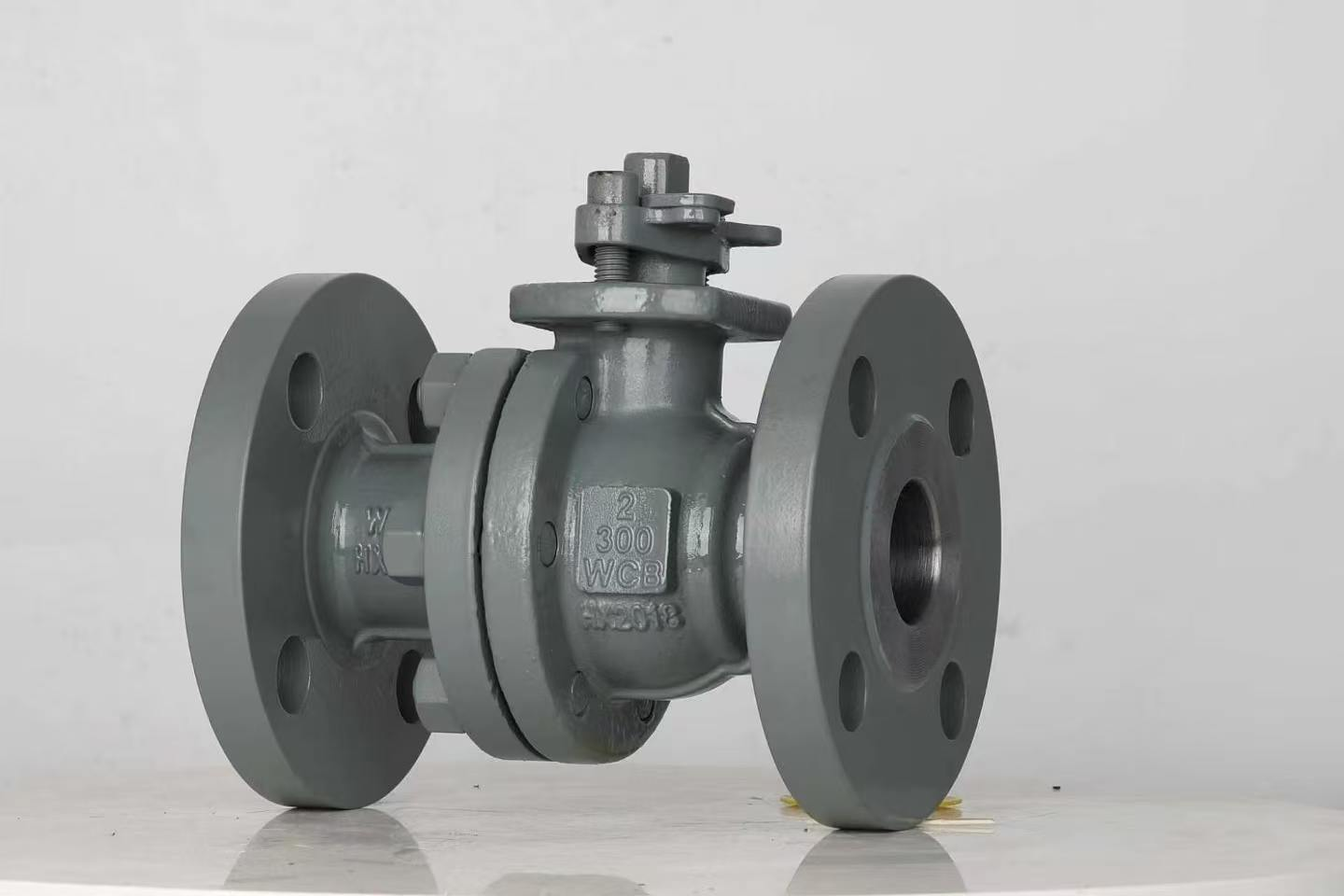
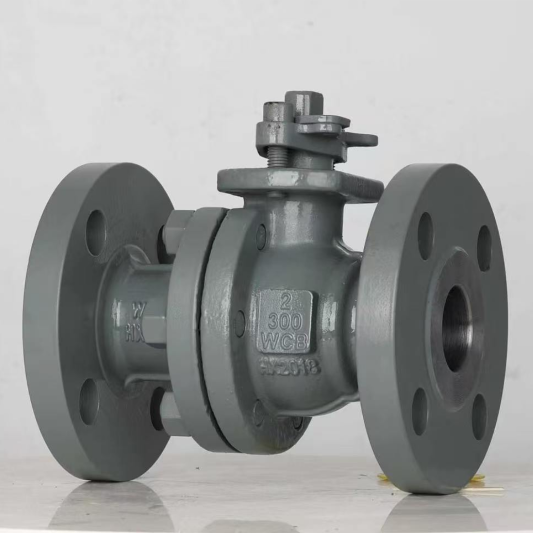
Figure 1. DN50 (2 inch) Class 300 floating ball valve in WCB body, with the size, class and material marked on the body casting. The ball is held only by the two seat rings. Shanghai Xiazhao Valve.
02 | The Contact Stress Number
Seat leakage is a contact stress problem, not a pressure problem. Thrust is differential pressure multiplied by bore area. Contact area is seat circumference multiplied by the width of the contact band. Divide one by the other and the bore cancels down to a single relationship.
sigma approx. dP x D / (4 x w) D = seat bore (mm), w = contact band (mm), dP in MPa, sigma in MPa
With a typical 3 mm contact band, a DN50 valve at 0.2 MPa develops about 0.8 MPa of seat contact stress. At 5.1 MPa, the Class 300 rating, the same seat sees about 21 MPa. A DN25 at 0.2 MPa sits near 0.4 MPa. Against an RPTFE seat whose compressive strength is in the tens of megapascals, the low-pressure case is loaded at a few percent of what the material can carry. The pressure contribution has effectively disappeared and the seal is running on preload alone.
Table 1. Indicative seat contact stress, 3 mm contact band
Bore |
0.2 MPa |
1.0 MPa |
2.0 MPa |
5.1 MPa (Class 300 rating) |
DN25 |
0.42 |
2.1 |
4.2 |
10.6 |
DN50 |
0.83 |
4.2 |
8.3 |
21.3 |
DN80 |
1.33 |
6.7 |
13.3 |
34.0 |
DN100 |
1.67 |
8.3 |
16.7 |
42.5 |
The table also explains a pattern that surprises buyers: the smaller the valve, the worse the low-pressure behaviour. A DN25 has less than half the contact stress of a DN50 at the same differential, because the thrust falls with the square of the bore while the contact circumference falls only linearly.
And it explains why class has no effect on this failure. Raising DN50 from Class 300 to Class 600 changes the rating, not the contact stress at 0.2 MPa. If the line runs at 0.2 MPa, the valve is a 0.2 MPa valve whatever is stamped on the body.
03 | Why the Preload Disappears Over Time
Preload is a stored spring force, from the seat geometry, the elastomer compression or an explicit spring. Three mechanisms consume it, and all three are invisible at the factory.
Compression set. A soft seat takes a permanent deformation under load, and the force that produced that deformation relaxes. A valve that sat closed at full differential for a year arrives at its first low-pressure duty with less preload than it had on the test bench.
Thermal cycling. Each cycle from ambient to line temperature and back relaxes a fraction of the preload, and the loss accumulates. A valve on a line that heats and cools daily is a different valve after two hundred cycles.
Long shut-in. A seat that stays pressed against an unmoving ball creeps. Breaking the seal and re-seating it restores some contact, which is why an operator who strokes a weeping valve twice often reports that it stopped leaking, at least for a while.
Gas service makes every one of these worse. A gas has no useful self-energising effect until pressure builds, and it also permeates the seat and decompresses through it on the way down. A soft-seated floating valve in low-pressure gas is one of the harder cases in any catalogue, and it is routinely specified as if it were water.
04 | Three Fixes That Work
Raising preload is the cheapest fix. A seat with a spring washer or a heavier seat spring holds contact stress above the sealing threshold at low differential. The cost appears at the other end of the range: more preload means more friction and more torque at high differential, and on a lever-operated DN50 that can be the difference between a lever and a gear.
Changing the seat principle is the more robust fix. A pressure-assisted seat with a separate piston seals on a small effective area, so the same line pressure produces far higher contact stress. The trade-off is directionality: a piston seat normally seals in one direction and must be specified with its orientation, and a bidirectional version usually costs more. For a low-pressure line that must hold in both directions, this is still often the correct answer.
Changing the design is the honest fix when the duty is genuinely difficult. At DN50, a trunnion or top-entry body with a spring-loaded seat gives predictable low-pressure behaviour, at a price that a commodity floating valve cannot match. It is worth it on a line where leakage has a consequence, and wasteful on a line where it does not.
What does not work is specifying a smaller valve, a higher class or a more expensive brand. None of those change the contact stress at 0.2 MPa. The number is set by bore, band width and preload.
05 | What to Put in the Specification
The specification should describe the lowest pressure at which the valve must seal, not only the highest pressure it must survive. Table 2 converts the usual field complaint into the line that should have been in the datasheet.
Table 2. Field symptom, cause and the specification line that prevents it
Symptom |
Most likely cause |
Line to add to the datasheet |
Weeps at low line pressure, seals at high |
Contact stress too low without pressure assist |
Low-pressure seat test at the minimum working differential |
Starts leaking after 6 to 12 months |
Compression set and thermal cycling |
Seat material and preload data, plus expected cycle count |
Leaks only in gas service |
No self-energising and permeation |
Seat type qualified for gas, with the test medium stated |
Leaks after long shut-in, stops after stroking |
Seat creep and stiction |
Seat design with spring assistance; periodic stroke requirement |
Leaks in both directions but passes factory test |
Test pressure different from service pressure |
Test at the service differential, recorded in the test report |
The acceptance criterion matters as much as the test pressure. Zero leakage is not a specification; leakage classes are. ISO 5208 Rate A means no visually detectable leakage, which is what buyers usually mean by zero. Rate B, C and D allow progressively more, scaled by DN, and a metal-seated valve is normally accepted against a later rate than a soft-seated one. Writing the rate, the medium and the pressure removes the argument at commissioning.
Five lines, in order:
- Minimum working differential pressure at which the valve must seal, stated as a value.
- Seat test at that pressure, in addition to the standard high-pressure seat test.
- Leakage acceptance by class, ISO 5208 Rate A to D, with the test medium named.
- Seat material and preload basis, requested from the manufacturer rather than assumed.
- Expected cycle count and shut-in duration, which decide whether compression set is a design issue.
Appendix A | Image Asset
Figure 1 is embedded in section 01 at its delivered resolution. The delivered file is 1440 x 960 px, which is adequate for a 15 cm web image but should be re-exported from the original photograph for print use.
Field |
|
File |
assets/xiazhao-dn50-class300-floating-ball-valve.jpg |
Subject |
DN50 Class 300 floating ball valve, WCB body, body marking 2 in / 300 / WCB visible |
Embedded size |
1440 x 960 px, landscape |
Alt text |
DN50 Class 300 floating ball valve, WCB body - Shanghai Xiazhao Valve |
Web export |
Long edge approx. 1600 px, WebP quality approx. 80, target under 150 KB |
Caption |
As printed under Figure 1; do not rewrite |
Appendix B | Standards Referenced and Data Notes
API 598.Valve Inspection and Testing. Defines shell and seat test requirements; the seat test pressure is a multiple of the rating, which is why it does not represent low-pressure service.
ISO 5208. Industrial valves - Pressure testing of metallic valves. Leakage rates A to D are expressed as allowable leakage per DN and per unit time, and are the correct way to state an acceptance criterion.
API 608. Metal Ball Valves - Flanged, Threaded, and Welding Ends. Covers the small-bore flanged range where floating designs are standard.
ASME B16.34. Valves - Flanged, Threaded, and Welding End. Class 300 carbon steel rating at 38 C is 51.0 bar, used here only as a reference pressure.