EN

Conventional vs Balanced Bellows vs Pilot-operated Safety Relief Valves: The Backpressure Numbers That Decide the Selection
Shanghai Xiazhao Valve · Technical note for process engineers and procurement
Selection sheets usually list three valve families without explaining why. In practice the choice is settled by two numbers: the superimposed backpressure sitting on the outlet, and the built-up backpressure generated during discharge. Get those wrong and the valve opens early, loses rated capacity, or chatters on the seat.
1. Two kinds of backpressure — do not mix them
Superimposed backpressure exists before the valve opens: pressure from a common flare header, from another valve discharging, or from a liquid leg in the outlet. It may be constant or variable. Built-up backpressure appears only while the valve itself is discharging, driven by the size of the outlet piping. A third number matters for stability: pressure loss in the inlet piping must stay below 3% of set pressure at rated flow, or the valve can chatter regardless of outlet design.
2. Force balance: why a conventional valve drifts
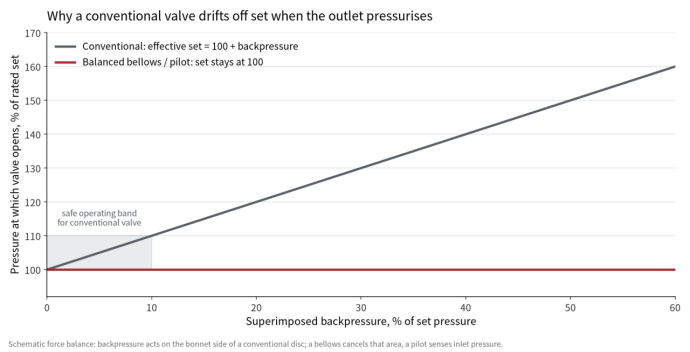
In a conventional spring-loaded valve, backpressure pushes on the top side of the disc holder over roughly the seat area. That force adds to the spring. Every 1 bar of superimposed backpressure raises the effective opening pressure by about 1 bar — a 1:1 drift off set. A balanced bellows cancels that area: the bellows effective diameter matches the seat, so backpressure on the disc is balanced by backpressure on the bellows. A pilot-operated valve senses inlet pressure and uses it to hold the main disc shut, so outlet pressure barely moves the set point.
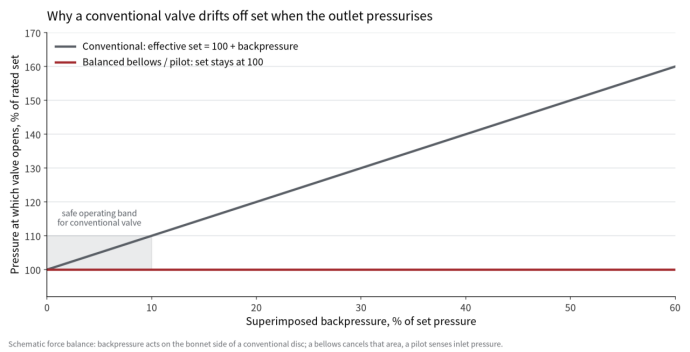
Figure 1. Effective opening pressure versus superimposed backpressure: conventional valves drift 1:1; balanced-bellows and pilot designs hold set.
3. The tolerance table that ends most selection arguments
Design |
Superimposed backpressure |
Built-up backpressure at rated flow |
Set-point stability |
Conventional spring-loaded |
keep near zero; adds 1:1 to opening pressure |
≤ 10% of set pressure |
drifts with outlet pressure |
Balanced bellows |
up to roughly 40–50% of set pressure |
10–20%, vendor-specific |
stable; Kb correction curve enters sizing above ~30% |
Pilot-operated |
up to near set pressure |
high; check vendor data |
stable; tight shutoff as a bonus |
Two installation rules that come with the bellows: its bonnet vent must always be open to atmosphere — never piped into a pressurised header — and flow out of that vent is the standard field signal that the bellows has ruptured.
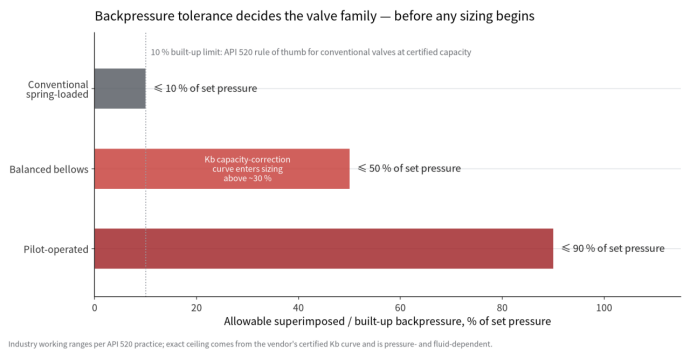
Figure 2. Working backpressure ranges by valve family. Exact ceilings come from the vendor's certified Kb curve and are pressure- and fluid-dependent.
4. Where each design goes wrong
- Conventional valve discharging into a live flare header: it opens early, every time, because the header pressure is already helping the spring.
- Balanced bellows in polymerising or fouling service: the bellows cavity blocks, and the "balanced" valve quietly becomes a conventional one.
- Pilot-operated valve on dirty or solids-laden service: the pilot orifice blocks; pilot designs want clean, filtered medium.
- Cost follows the same order: conventional is cheapest, balanced bellows adds the bellows element, pilot-operated adds the pilot assembly and the most maintenance points.
5. Three questions before you accept a selection
- What is the superimposed backpressure range, in percent of set pressure, at maximum and minimum header loading?
- What is the built-up backpressure at certified capacity, and is it within the chosen design's limit?
- Which Kb capacity correction did the sizing use, and does the vendor's curve actually cover that backpressure?
6. Piping rules that make the selection real
- Inlet line loss: total pressure drop between the vessel nozzle and the valve inlet must stay below 3% of set pressure at rated flow. Exceed it and even a correctly selected valve chatters after partial lift.
- Outlet piping is sized so built-up backpressure at certified flow stays inside the chosen design\u2019s limit — resizing the outlet is usually cheaper than uprating the valve family.
- Isolation valves between vessel and valve must be full-bore and locked or car-sealed open; a reduced-port isolation valve is inlet-line loss in disguise.
- Discharge lines routed to a common flare are where superimposed backpressure is born — which is why header pressure should be fixed at the P&ID review, not after the supplier list closes.
Shanghai Xiazhao Valve builds conventional and balanced-bellows API 526 flanged pressure relief valves, with sizing sheets that state superimposed backpressure, built-up backpressure and the Kb used. Send your flare-header pressure and relieving rate for a selection check.
Keywords: conventional vs balanced bellows vs pilot operated, pressure relief valve backpressure, API 520 backpressure correction Kb, safety valve selection, flare header PSV, balanced bellows relief valve
Table of Contents
- Conventional vs Balanced Bellows vs Pilot-operated Safety Relief Valves: The Backpressure Numbers That Decide the Selection
- 1. Two kinds of backpressure — do not mix them
- 2. Force balance: why a conventional valve drifts
- 3. The tolerance table that ends most selection arguments
- 4. Where each design goes wrong
- 5. Three questions before you accept a selection
- 6. Piping rules that make the selection real