EN
Body and Trim Materials for API 526 Pressure Relief Valves: WCB, CF8M, Duplex and Stellite in Real Service
Shanghai Xiazhao Valve · Technical note for process engineers and procurement
Buyers often write "316 stainless valve" on an inquiry and get a 316 trim inside a carbon-steel casting — or the reverse. Body material and trim answer different questions: the body survives pressure and environment, the trim survives the seat. This article separates the two and gives the numbers a specification needs.
1. Body and bonnet: temperature is the first filter
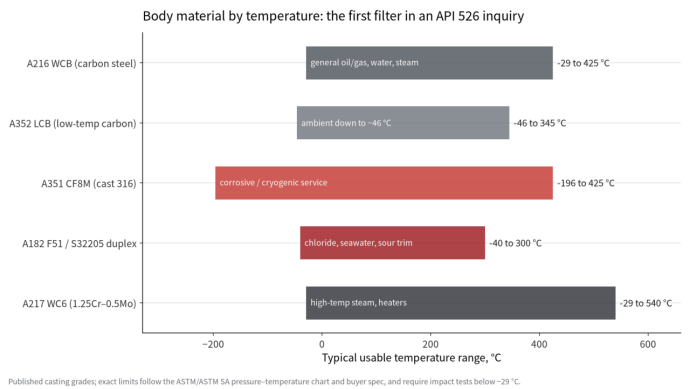
Cast body grades cover a wide temperature envelope, and the envelope, not the price, decides the shortlist. Below −29 °C a standard WCB casting needs impact testing; below that you move to LCB, and below roughly −46 °C to LCC or austenitic stainless. At the hot end, WCB tops out near 425 °C and alloy WC6 covers heater and steam duty to about 540 °C.
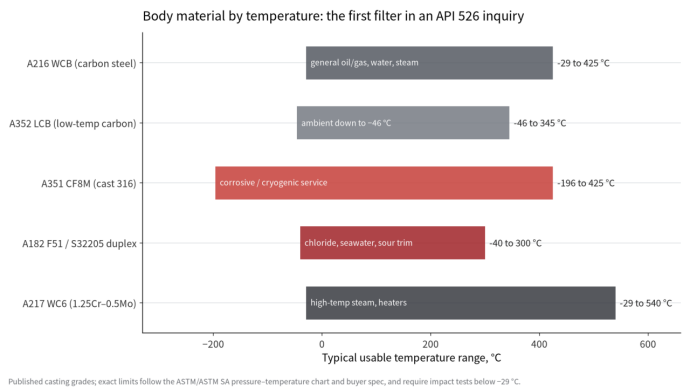
Figure 1. Typical usable temperature ranges of common API 526 body casting grades. Exact limits follow the ASTM pressure\u2013temperature chart and the buyer spec.
Grade |
Typical range |
Typical service |
A216 WCB |
−29 to 425 °C |
general oil/gas, water, steam |
A352 LCB |
−46 to 345 °C |
low-temperature ambient service |
A351 CF8M (cast 316) |
−196 to 425 °C |
corrosive and cryogenic service |
A182 F51 / S32205 duplex |
−40 to 300 °C |
chloride, seawater, sour trim |
A217 WC6 (1.25Cr–0.5Mo) |
−29 to 540 °C |
high-temperature heaters, steam |
Two notes buyers miss: cast CF8M at cryogenic temperatures requires the appropriate impact test, not just the grade on paper; and sour service (NACE MR0175 / ISO 15156) caps body hardness at about 22 HRC, which means WCB with post-weld heat treatment rather than a harder casting.
2. Trim: what actually seals and pops
The trim is the disc, nozzle, stem and spring contact surfaces. On metal-seated relief valves the common arrangement is a 316 stainless base with Stellite 6 hardfacing on the seating faces, running at roughly 36–45 HRC. Two trim rules matter commercially:
- Hardness differential of 3–5 HRC between disc and nozzle keeps one face from galling or embedding into the other after repeated pops — the same rule that keeps API 527 bubble counts low, as covered in our seat tightness modeling note.
- Soft seats buy tightness at the price of cycle life. PTFE or RTFE seats reach zero bubbles per minute and handle roughly up to 200 °C, but they erode in dirty or steam service. Metal seats survive steam and particulates and accept the API 527 bubble limits instead.
3. Sour service: the hardness clause that kills the cheapest quote
For H₂S service the body and bonnet are usually WCB or CF8M with PWHT and a maximum hardness of 22 HRC; bolting moves to A193 B7M studs with A194 2HM nuts. A carbon-steel casting that looks identical on a nameplate is not interchangeable once sour service is invoked — the heat treatment and the test certificate are the deliverable.
4. Three questions for a material inquiry
- What is the body/bonnet grade, and what is the trim number? "Stainless" on a quote should expand into both.
- What is the measured seat-face hardness after hardfacing, and what is the disc-to-nozzle hardness differential?
- Metal seat or soft seat, and which service temperature and medium drive that choice?
5. Spring and flange materials ride along
The spring is the third material decision buyers forget. Standard chrome-vanadium spring steel covers ambient to roughly 250–300 °C; high or sour service moves to Inconel X-750, which holds its load in corrosive atmosphere. A spring rated for 100 bar at shop temperature that loses load at 400 °C is a set-point drift nobody traces back to the spring.
Flange facing follows pressure and service: raised face is standard through Class 300; ring-type joint (RTJ) facings are expected on Class 600 and above and on high-temperature duty — the same RTJ outlet face visible on our finished valve photographs. Specify facing and bolt rating on the inquiry, not on receipt.
Shanghai Xiazhao Valve supplies API 526 flanged steel pressure relief valves in WCB, CF8M and duplex construction with Stellite-hardfaced trim, and documents body hardness and seat tightness per API 527 on the test certificate. Send your medium, temperature and sour-service requirement for a material recommendation.
Keywords: API 526 valve materials, WCB vs CF8M pressure relief valve, duplex safety valve body, Stellite 6 trim, sour service relief valve NACE MR0175, cryogenic safety valve material
Table of Contents
- Body and Trim Materials for API 526 Pressure Relief Valves: WCB, CF8M, Duplex and Stellite in Real Service
- 1. Body and bonnet: temperature is the first filter
- 2. Trim: what actually seals and pops
- 3. Sour service: the hardness clause that kills the cheapest quote
- 4. Three questions for a material inquiry
- 5. Spring and flange materials ride along