EN

Key Takeaways
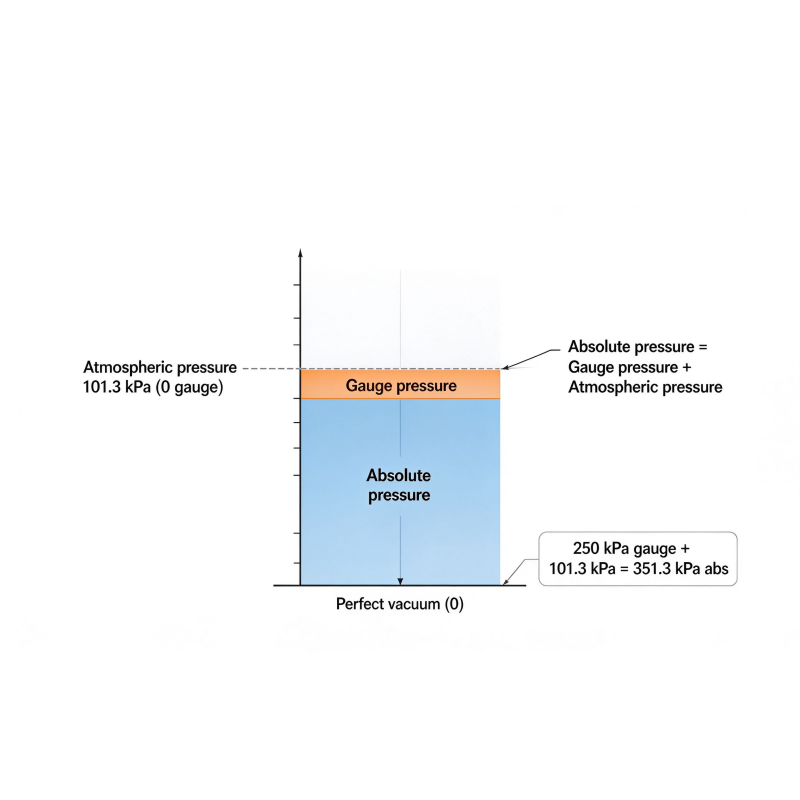
- Gauge pressure reads against current atmospheric pressure; absolute pressure reads against a perfect vacuum.
- Absolute pressure = gauge pressure + atmospheric pressure.
- At sea level, atmospheric pressure ≈ 101.3 kPa ≈ 1.013 bar ≈ 14.7 psi ≈ 760 mmHg.
- Most mechanical pressure gauges read gauge pressure; vacuum gauges and absolute pressure transmitters read absolute pressure.
- On international projects, always confirm whether a specified “psi”, “bar”, “kPa”, or “MPa” means gauge or absolute.
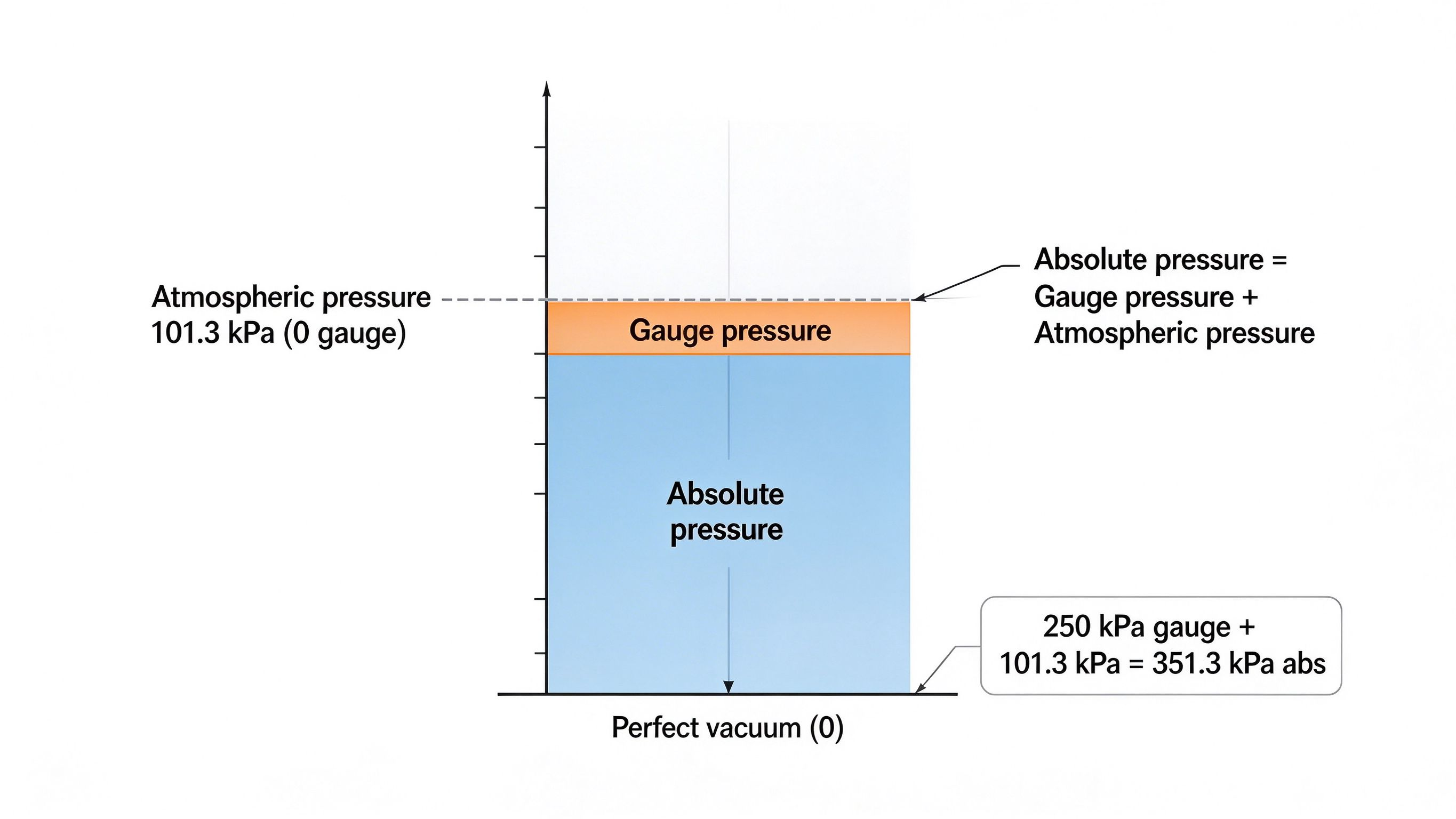
Absolute vs gauge pressure on the same scale: gauge pressure reads from atmospheric pressure, absolute pressure reads from perfect vacuum.
Introduction
Absolute pressure and gauge pressure are two different ways of expressing the same physical quantity — and mixing them up has real consequences. Engineers and buyers who work with pressure gauges, pressure transmitters, vacuum instruments, or valves deal with this distinction every day.
When the reference is wrong:
- A valve may be rated for the wrong pressure class.
- A transmitter may be selected with an incorrect range.
- A vacuum system may be designed against the wrong datum.
This guide explains the difference between absolute and gauge pressure, gives the conversion formula, works through concrete examples, provides a unit conversion table, and shows how the distinction affects valve and instrument selection.
1. What is gauge pressure?
Gauge pressure is measured relative to the current atmospheric pressure. The reading on a typical mechanical pressure gauge is gauge pressure.
Example: a car tire at 250 kPa reads 250 kPa gauge — in other words, 250 kPa higher than the surrounding atmosphere.
Common applications of gauge pressure:
- Car tires
- Water pipe systems
- Compressed air lines
- Hydraulic systems
- Most mechanical pressure gauges
By default, a pressure value written without a suffix (“a” or “g”) is normally treated as gauge pressure:
250 kPa = 250 kPa gauge
250 kPag = 250 kPa gauge
psig = pounds per square inch gauge
2. What is absolute pressure?
Absolute pressure is measured relative to a perfect vacuum. It expresses the true physical pressure of a gas or liquid, and it is the value you need in:
- Vacuum systems
- Chemical and distillation processes
- Cryogenic systems
- High-precision pressure measurement
- Absolute pressure transmitters
Example: if a car tire reads 250 kPa gauge and the local atmospheric pressure is about 101 kPa:
Absolute pressure = gauge pressure + atmospheric pressure
Absolute pressure = 250 kPa + 101 kPa = 351 kPa
So the tire’s absolute pressure is about 351 kPa absolute, written 351 kPa(abs) or 351 kPa(a).
3. The formula connecting the two
Absolute pressure = Gauge pressure + Atmospheric pressure
Gauge pressure = Absolute pressure − Atmospheric pressure
Under standard atmospheric conditions:
Atmospheric pressure ≈ 101.3 kPa ≈ 1.013 bar ≈ 14.7 psi ≈ 760 mmHg
Table 1. Gauge-to-absolute conversion examples
Condition |
Gauge pressure |
Atmospheric pressure |
Absolute pressure |
Standard atmosphere |
0 kPa |
101.3 kPa |
101.3 kPa |
Car tire |
250 kPa |
101.3 kPa |
351.3 kPa |
Compressed air line |
700 kPa |
101.3 kPa |
801.3 kPa |
Full vacuum |
−101.3 kPa |
101.3 kPa |
0 kPa |
4. Why atmospheric pressure matters
At sea level, atmospheric pressure is roughly:
101.3 kPa = 1.013 bar = 14.7 psi = 760 mmHg
Atmospheric pressure falls with altitude:
Table 2. Approximate atmospheric pressure vs altitude
Location |
Approx. atmospheric pressure |
Sea level |
101.3 kPa |
1,000 m |
≈ 90 kPa |
2,000 m |
≈ 80 kPa |
3,000 m |
≈ 70 kPa |
5,000 m |
≈ 54 kPa |
This is why breathing is harder at high altitude — the absolute oxygen pressure is lower. For instruments, the practical consequences are:
- A gauge pressure transmitter reading can drift with weather and altitude.
- An absolute pressure transmitter holds a stable zero at vacuum.
- Vacuum measurement is normally expressed as absolute pressure.
5. How to read mechanical pressure gauges
Most mechanical pressure gauges show gauge pressure. There are three common types:
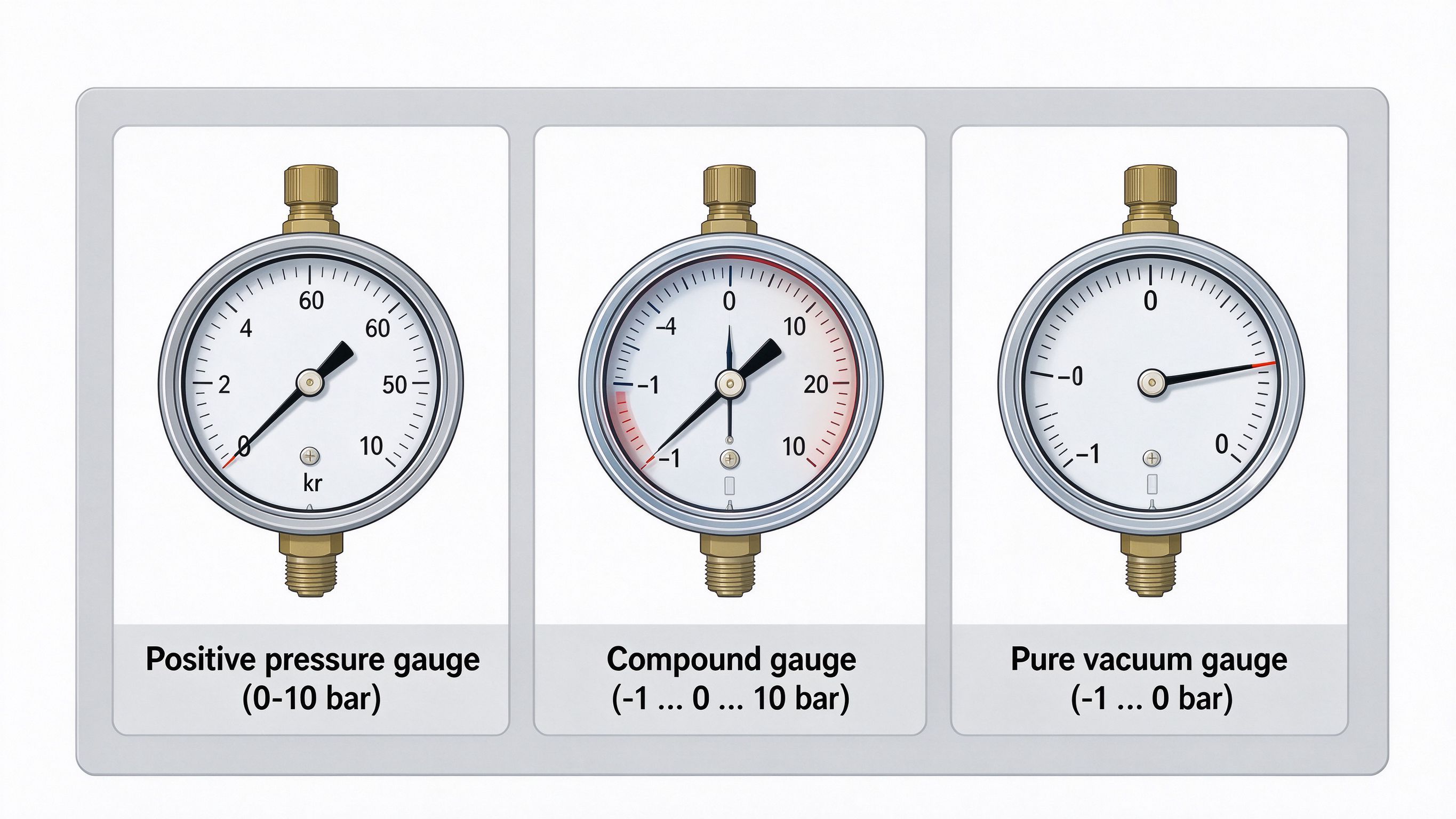
The three common mechanical pressure gauge types: positive, compound, and pure vacuum.
5.1 Positive pressure gauge
Typical range: 0–100 kPa / 0–1,000 kPa / 0–10 bar. The pointer sits at 0 at atmospheric pressure. This is the most common type for pumps, pipelines, compressed air, and water systems.
5.2 Compound pressure / vacuum gauge
Typical range: −101 kPa to 0 to 700 kPa, or −1 bar to 0 to 10 bar. Zero sits in the middle of the scale and corresponds to atmospheric pressure. These gauges measure vacuum on one side and positive gauge pressure on the other.
5.3 Pure vacuum gauge
Typical range: −101 kPa to 0 kPa. Atmospheric pressure reads 0 kPa gauge; full vacuum reads −101 kPa gauge, which equals 0 kPa absolute. Today, vacuum is more commonly measured with absolute pressure transmitters than with pure mechanical vacuum gauges.
6. Pressure unit conversion table
Different industries use different pressure units. Common conversions:
1 Torr = 1 mmHg ≈ 133 Pa
1 mbar = 0.001 bar = 100 Pa
1 bar = 100 kPa = 0.1 MPa
1 bar ≈ 14.5 psi
1 MPa = 10 bar ≈ 145 psi
1 psi ≈ 6.895 kPa
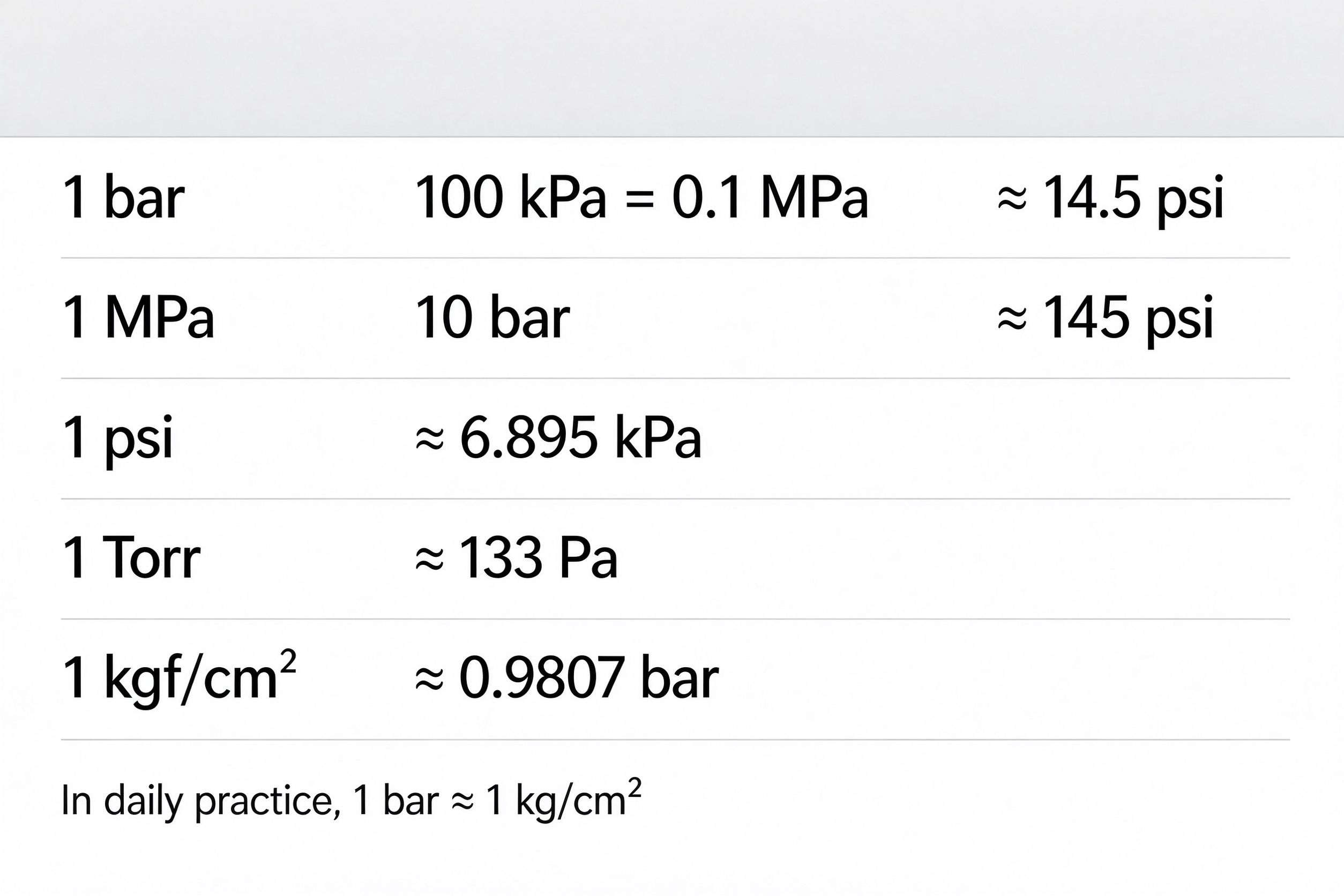
Quick pressure unit conversion reference card.
Table 3. Quick pressure conversions
Unit |
Equivalent |
1 bar |
100 kPa |
1 bar |
0.1 MPa |
1 bar |
14.5 psi |
1 MPa |
10 bar |
1 MPa |
145 psi |
1 psi |
6.895 kPa |
1 kPa |
0.01 bar |
1 kPa |
0.145 psi |
In many markets, people treat 1 bar ≈ 1 kg/cm². Strictly speaking, 1 kgf/cm² = 0.980665 bar, but the approximation is common in daily engineering practice.
7. What do psig and psia mean?
In English technical documents, you will see:
psig = pounds per square inch gauge
psia = pounds per square inch absolute
Examples, with atmospheric pressure at 14.7 psi:
100 psig = 100 + 14.7 = 114.7 psia
100 psia = 100 − 14.7 = 85.3 psig
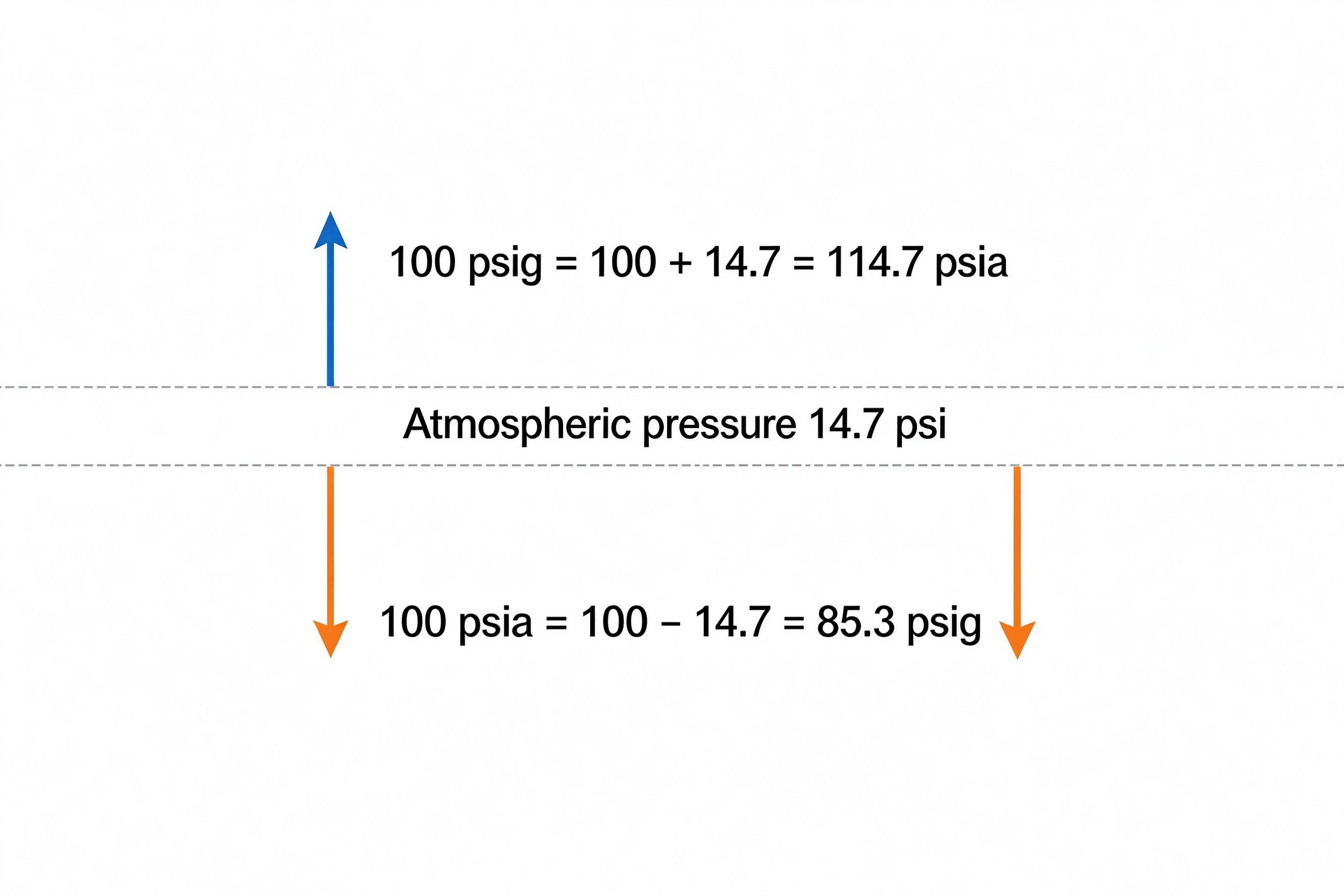
psig vs psia: 100 psig = 114.7 psia with atmospheric pressure at 14.7 psi.
This matters on international projects. If a specification says only “psi”, always confirm whether it means gauge or absolute.
8. Gauge vs absolute pressure in valve and instrument selection
For valves, pressure ratings are often given as gauge pressure — but not always. For instruments, the reference must be identified clearly.
Table 4. Typical pressure reference by device
Device |
Typical reference |
Mechanical pressure gauge |
Gauge |
Tire pressure gauge |
Gauge |
Gauge pressure transmitter |
Gauge |
Absolute pressure transmitter |
Absolute |
Vacuum gauge |
Absolute |
Vacuum transmitter |
Absolute |
Pressure relief valve set pressure |
Usually gauge |
Pipeline design pressure |
Usually gauge |
Vacuum system design pressure |
Usually absolute |
When selecting a valve or instrument, check:
- Is the stated value gauge or absolute?
- What is the local atmospheric pressure?
- Is the application above or below atmospheric pressure?
- Does the instrument output match the control system?
- What unit is used — bar, kPa, MPa, psi, psig, or psia?
9. Worked example: valve and transmitter selection
A customer states: operating pressure 0.6 MPa, vacuum distillation service, pressure transmitter. This specification is incomplete.
If 0.6 MPa gauge is meant:
Absolute pressure = 0.6 MPa + 0.1013 MPa = 0.7013 MPa(a)
If 0.6 MPa absolute is meant:
Gauge pressure = 0.6 MPa − 0.1013 MPa = 0.4987 MPa(g)
The difference between the two readings is about 0.2026 MPa — roughly 2 bar. In a vacuum distillation service, that is not a rounding error; it would mean the wrong transmitter range and valve class.
10. Summary
- Gauge pressure uses atmospheric pressure as zero.
- Absolute pressure uses perfect vacuum as zero.
- Absolute pressure = gauge pressure + atmospheric pressure.
- At sea level, atmospheric pressure ≈ 101.3 kPa ≈ 1.013 bar ≈ 14.7 psi.
- Most mechanical pressure gauges read gauge pressure.
- Vacuum gauges and absolute pressure transmitters read absolute pressure.
- psig = gauge pressure; psia = absolute pressure.
- Always confirm gauge vs absolute on international projects.
FAQ
What is the difference between absolute pressure and gauge pressure?
Absolute pressure is measured from a perfect vacuum. Gauge pressure is measured from the local atmospheric pressure.
How do I convert gauge pressure to absolute pressure?
Absolute pressure = gauge pressure + atmospheric pressure.
How do I convert absolute pressure to gauge pressure?
Gauge pressure = absolute pressure − atmospheric pressure.
Is 100 psig the same as 100 psia?
No. With atmospheric pressure at 14.7 psi: 100 psig = 114.7 psia, and 100 psia = 85.3 psig.
Do mechanical pressure gauges show absolute pressure?
Most show gauge pressure. Absolute pressure gauges exist, but they are less common in general mechanical pressure measurement.
Why do vacuum systems use absolute pressure?
Vacuum is below atmospheric pressure. Absolute pressure gives a clear zero reference from 0 kPa(abs) up to atmospheric pressure.
About Shanghai Xia Zhao Valve
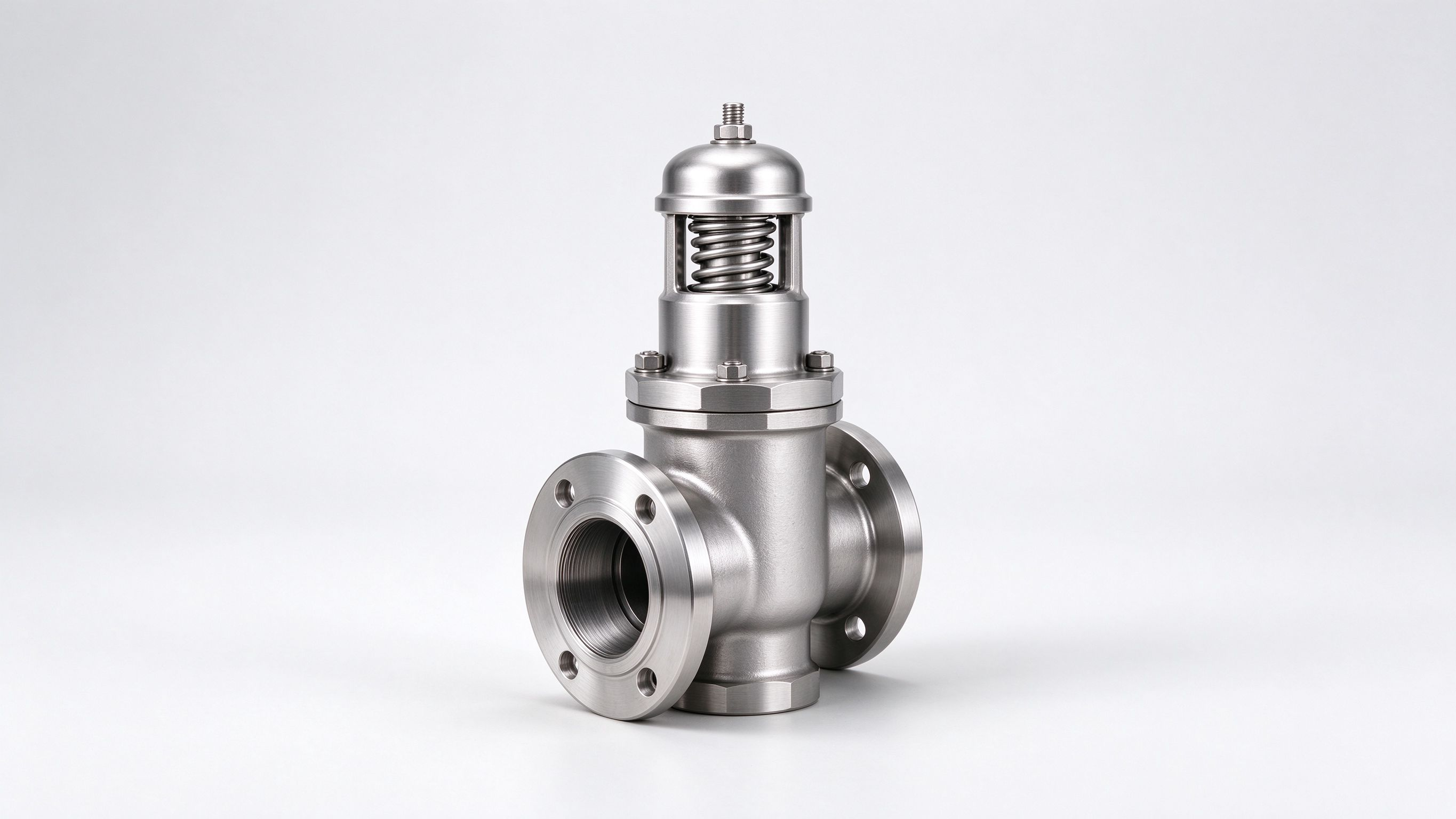
Spring-loaded stainless steel safety valve (product photo).
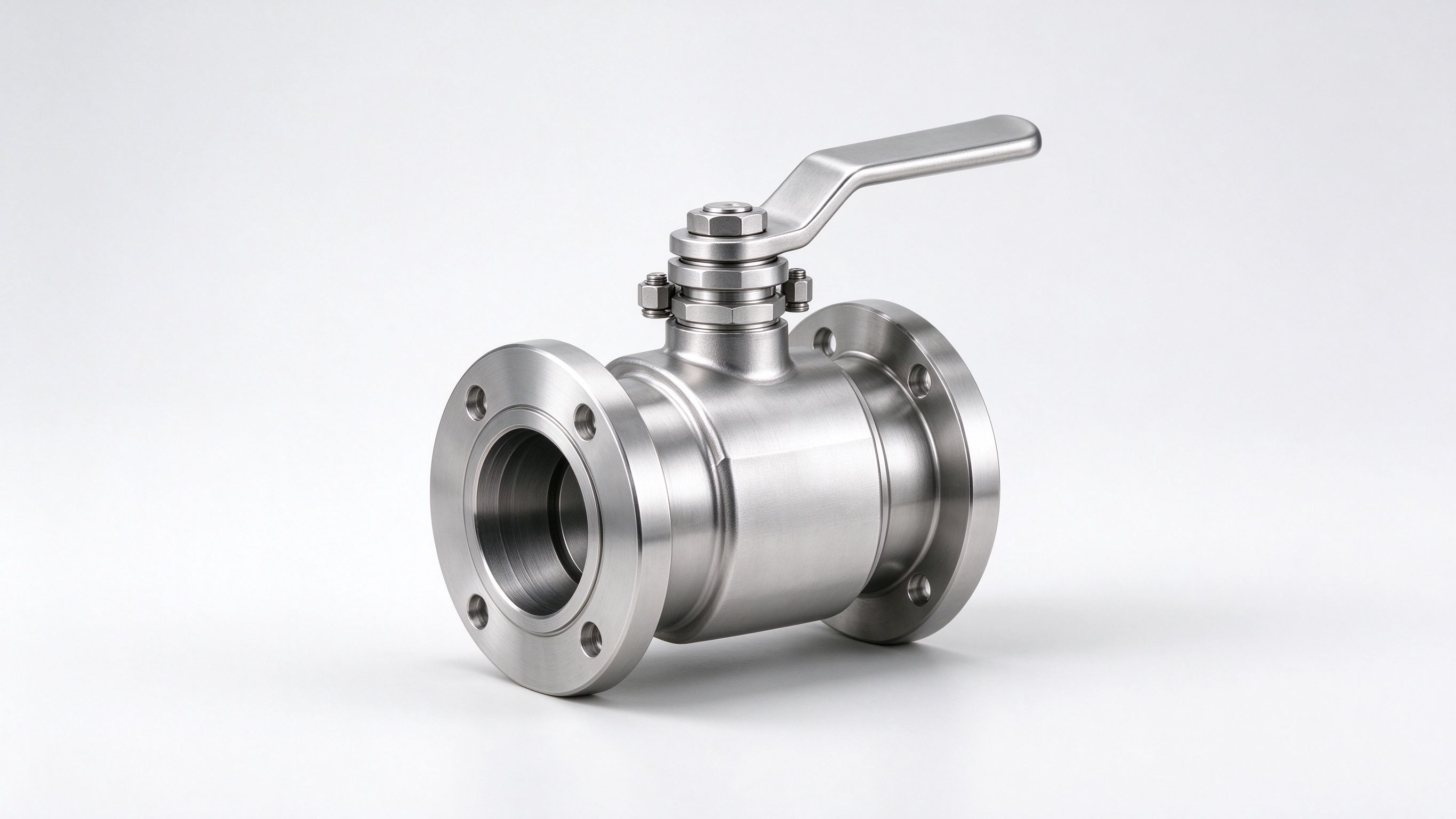
Three-piece stainless steel ball valve with lever handle (product photo).
Shanghai Xia Zhao Valve supplies industrial valves, pressure instruments, and fluid-control solutions to customers worldwide, serving water treatment, chemical processing, HVAC, oil and gas, power generation, and vacuum systems.
For valve or pressure-instrument selection, send our engineering team your working pressure, medium, temperature, and connection standard — and state whether your pressure values are gauge or absolute.
Table of Contents
- Key Takeaways
- Introduction
- 1. What is gauge pressure?
- 2. What is absolute pressure?
- 3. The formula connecting the two
- 4. Why atmospheric pressure matters
- 5. How to read mechanical pressure gauges
- 6. Pressure unit conversion table
- 7. What do psig and psia mean?
- 8. Gauge vs absolute pressure in valve and instrument selection
- 9. Worked example: valve and transmitter selection
- 10. Summary
-
FAQ
- What is the difference between absolute pressure and gauge pressure?
- How do I convert gauge pressure to absolute pressure?
- How do I convert absolute pressure to gauge pressure?
- Is 100 psig the same as 100 psia?
- Do mechanical pressure gauges show absolute pressure?
- Why do vacuum systems use absolute pressure?
- About Shanghai Xia Zhao Valve