EN
EN


Gauge Pressure vs Absolute Pressure: What's the Difference? MPa, psi, kg/cm² Conversion Guide for PSV & Safety Valve Selection
Understanding the difference between gauge pressure and absolute pressure is the core foundation for accurate pressure relief valve (PSV), spring‑loaded safety valve, and rupture disc selection. For engineers and procurement teams in oil & gas, chemical, power plant, and pharmaceutical industries, confusing these two pressure references is one of the most common causes of psv valve mis‑sizing, system overpressure risks, and equipment operational failures. Even for auxiliary equipment such as a pressure relief valve engine assembly or propane tank safety valve, wrong pressure reference setting will lead to hidden safety hazards.
This professional guide clarifies gauge vs absolute pressure definitions, core formulas, industrial application scenarios, and universal pressure unit conversions (MPa, psi, kg/cm², bar). It delivers practical on‑site rules to help global industrial users and buyers sourcing from pressure relief valve manufacturer & relief valves manufacturers select qualified pressure safety valve psv and pressure relief valves efficiently and accurately.
1. Gauge Pressure vs Absolute Pressure: Core Definition & Differences
All pressure detection and safety valve set pressure standards are based on different zero reference points. The essential distinction between gauge pressure and absolute pressure lies in their benchmark, which directly determines the applicability of PSV and safety valve parameter settings in industrial systems.
1.1 Absolute Pressure (P_abs / abs)
Zero Reference: Complete absolute vacuum (theoretical zero pressure with no molecular activity).
Value Characteristic: Always positive, no negative value exists.
Industrial Applications: Mainly used for precise thermodynamic calculations, vacuum system monitoring, meteorological detection, and altimeter data calibration. It is rarely used for conventional safety valve set pressure settings in industrial plants.
1.2 Gauge Pressure (P_g / G)
Zero Reference: Local standard atmospheric pressure.
Value Characteristic: Can be positive (system pressure higher than atmospheric pressure) or negative (vacuum state).
Industrial Applications: The universal standard for 99% of on‑site industrial pressure measurement and safety valve configuration, covering core scenarios:
- PSV (pressure safety valve) set pressure and reseat pressure calibration
- Spring‑loaded safety valve pop pressure parameter setting
- Engine and propane tank safety valve pressure configuration
- Pipeline pressure monitoring, boiler pressure control, and oil pressure control valve system debugging
- Calibration for autoclave safety valve used in pharmaceutical sterilization processes
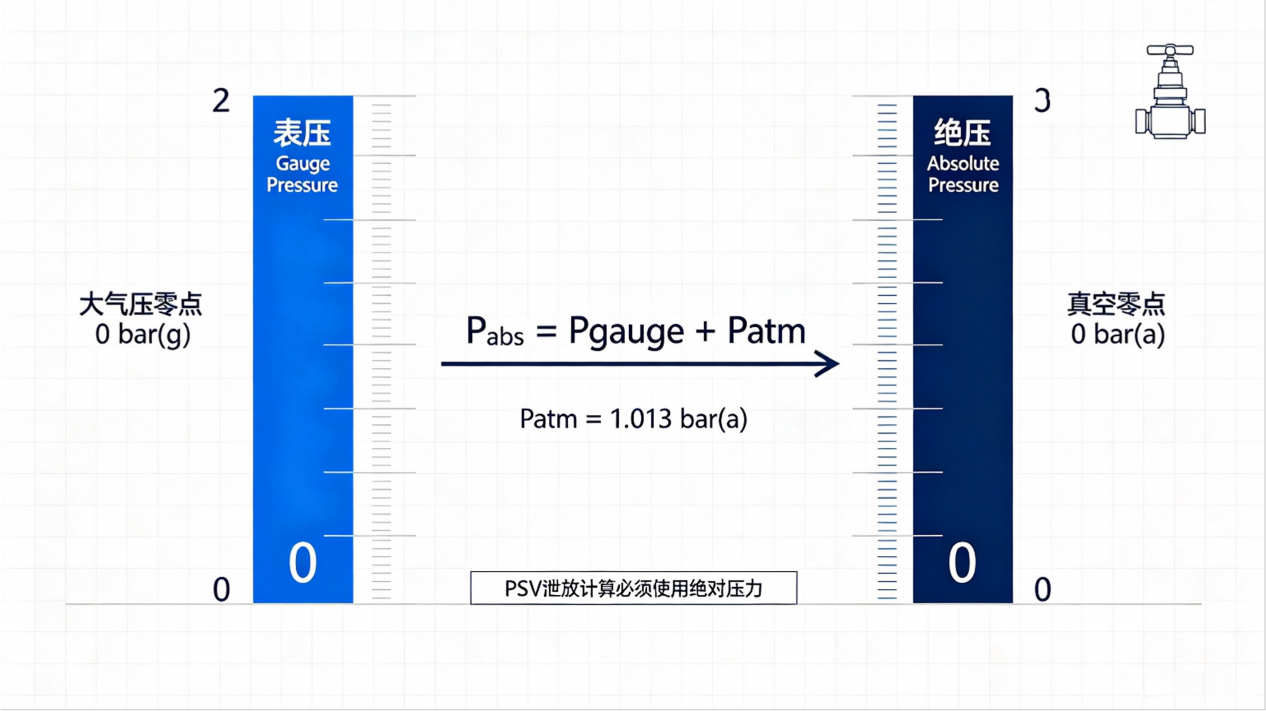
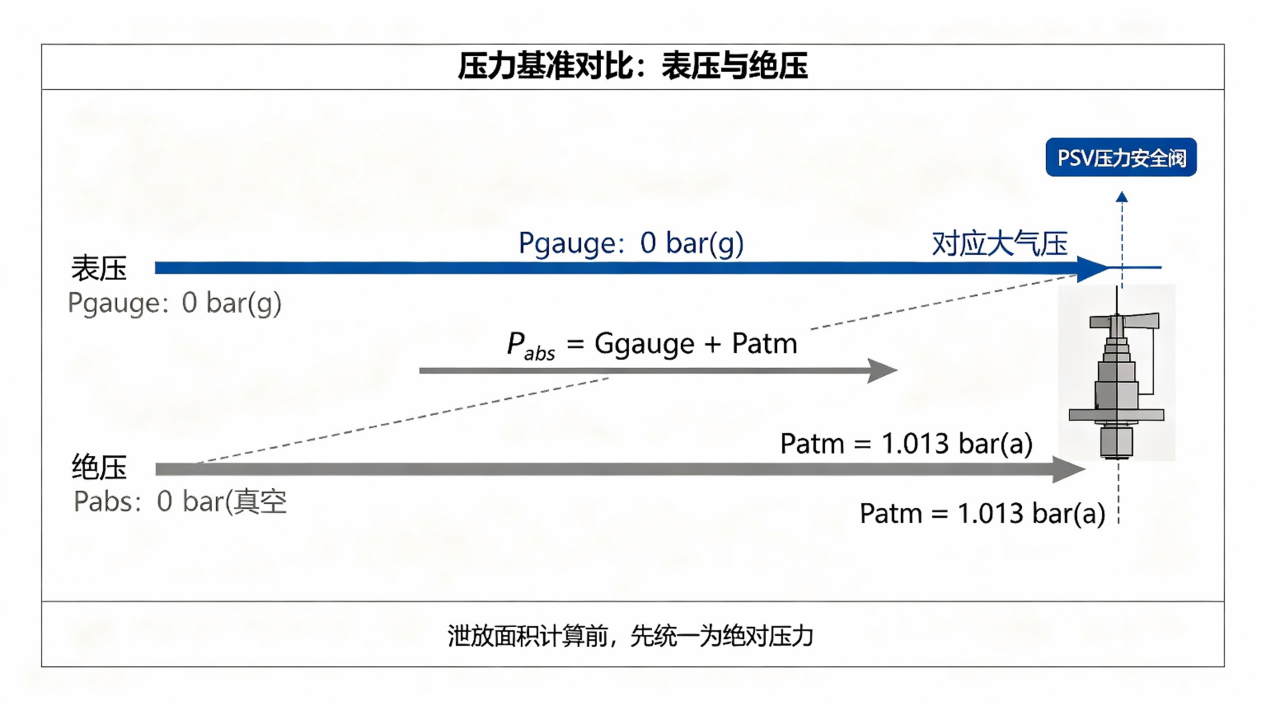
1.3 Core Conversion Formula (Industrial Must‑Memorize)
Absolute Pressure = Gauge Pressure + Local Atmospheric Pressure
Engineering Quick Reference: Standard atmospheric pressure ≈ 101.325 kPa ≈ 0.1 MPa ≈ 1 kg/cm² ≈ 14.7 psi. For most conventional industrial PSV selection and pressure calculation scenarios, 0.1 MPa or 1 kgf/cm² can be used for approximate rounding calculation.
1.4 Real Industrial Cases for Valve System Application
Case 1: Petrochemical Reactor Positive Pressure System
Field gauge reading: 2.5 MPa (gauge pressure), local atmospheric pressure: 0.1 MPa.
- Gauge pressure 2.5 MPa: The standard set pressure for spring‑loaded safety valve operation.
- Absolute pressure 2.6 MPa: Used for auxiliary equipment compressor ratio calculation and system thermodynamic analysis.
Case 2: Pharmaceutical Distillation Column Vacuum System
Field gauge reading: ‑0.08 MPa (negative gauge pressure).
Absolute pressure = ‑0.08 + 0.1 ≈ 0.02 MPa. This true vacuum data is the key basis for selecting vacuum‑rated PSVs and matching rupture disc valve to avoid vacuum system overpressure damage.
2. Industrial Pressure Unit Conversion: Global Valve Standard Universal Rules
Global valve industries adopt different standard units: MPa (Chinese GB standard), psi (American ASME standard), bar (European DIN standard), and kgf/cm² (commonly used in Asian manufacturing plants). Unified unit conversion is the premise of accurate cross‑border pressure relief valve procurement and parameter matching, especially when specifying fire safe ball valve, main pressure relief valve and custom autoclave safety valve for international projects.
As a professional global pressure relief valve manufacturer, Xiazhao Valve sorts out authoritative and practical conversion benchmarks and on‑site quick‑calculation rules for industrial engineers and procurement personnel working with pressure relief valves.
2.1 Core Pressure Unit Conversion Benchmarks
Unit Conversion |
Industrial Application Notes |
1 MPa ≈ 10 bar |
Universal standard for industrial pumps and compressors |
1 MPa ≈ 10.2 kgf/cm² |
Referred to as "10 kg" in workshop daily operation |
1 bar = 100 kPa |
Widely used in European imported valve equipment |
1 psi ≈ 6.895 kPa |
Standard unit for ASME‑certified valves and pneumatic components, including fire safe ball valve |
1 atm = 101.325 kPa |
International standard atmospheric pressure |
2.2 On‑Site Quick Conversion Rules for Engineers
- MPa to kg/cm²: Multiply by 10 (approximate calculation), e.g., 0.5 MPa ≈ 5 kg/cm²
- psi to MPa: Divide by 145, e.g., 100 psi ≈ 0.69 MPa (common rating for fire safe ball valves)
- psi to kg/cm²: Divide by 14.2, e.g., 142 psi ≈ 10 kg/cm²
3. Full Pressure Conversion Table for Professional PSV Sizing
This table covers common industrial pressure grades, matching corresponding valve application scenarios, supporting quick selection of safety valves, psv valve and pressure relief devices for different process systems.
MPa |
bar |
kPa |
kgf/cm² (kg) |
psi |
Typical Valve Application Scenarios |
0.01 |
0.1 |
10 |
0.102 |
1.45 |
Low‑pressure steam system, tank blanketing protection |
0.1 |
1.0 |
100 |
1.02 |
14.5 |
Compressed air system, plant utility pipeline protection |
0.5 |
5.0 |
500 |
5.10 |
72.5 |
Conventional chemical process pipeline overpressure protection |
1.0 |
10.0 |
1000 |
10.20 |
145.0 |
Common spring‑loaded safety valve standard set pressure range |
2.0 |
20.0 |
2000 |
20.39 |
290.1 |
High‑pressure reactor, boiler drum pressure relief system, configure main pressure relief valve |
5.0 |
50.0 |
5000 |
50.99 |
725.2 |
Hydraulic system, high‑pressure gas storage tank protection, matched with oil pressure control valve |
10.0 |
100.0 |
10000 |
101.97 |
1450.4 |
Special high‑pressure equipment, customized autoclave safety valve psv safety valve |
4. 4 Common Pressure Calculation Mistakes & Professional Avoidance Tips
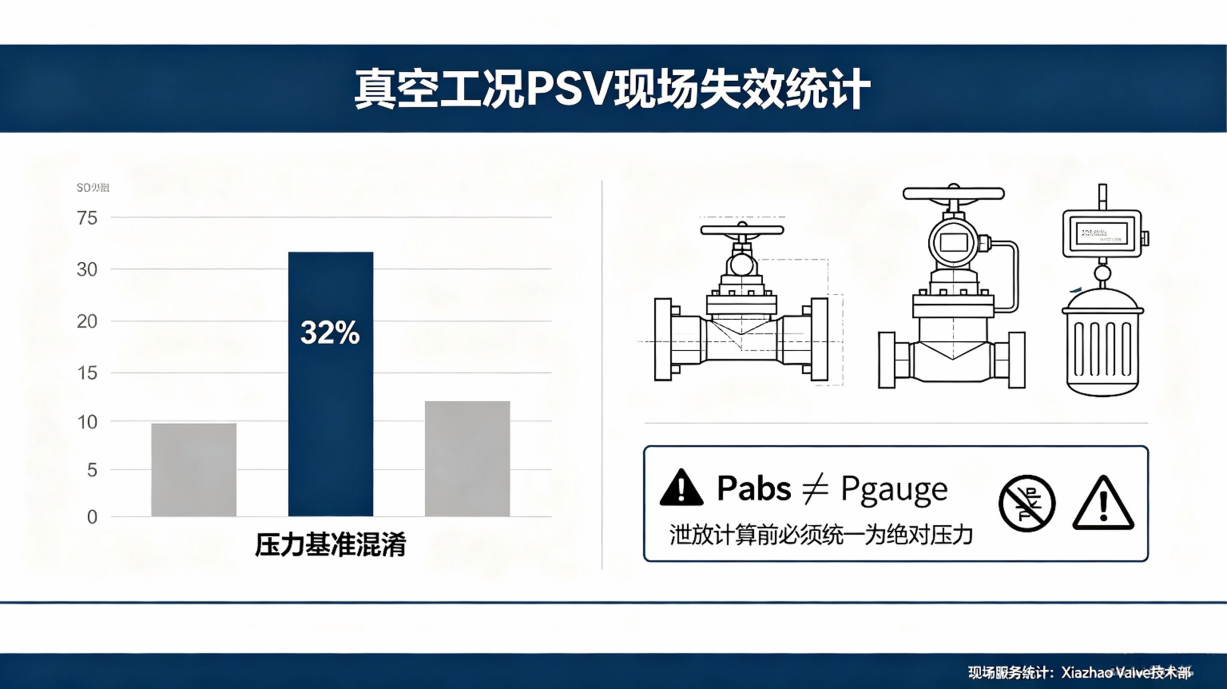
With more than 10 years of service experience in global oil refineries, chemical plants, power stations, and pharmaceutical factories, Xiazhao Valve has summarized four typical pressure reference and unit errors that easily cause PSV failure and system hidden dangers. According to our after‑sales database, nearly 28 % of returned pressure safety valve psv are caused by pressure‑reference mis‑interpretation rather than manufacturing defects.
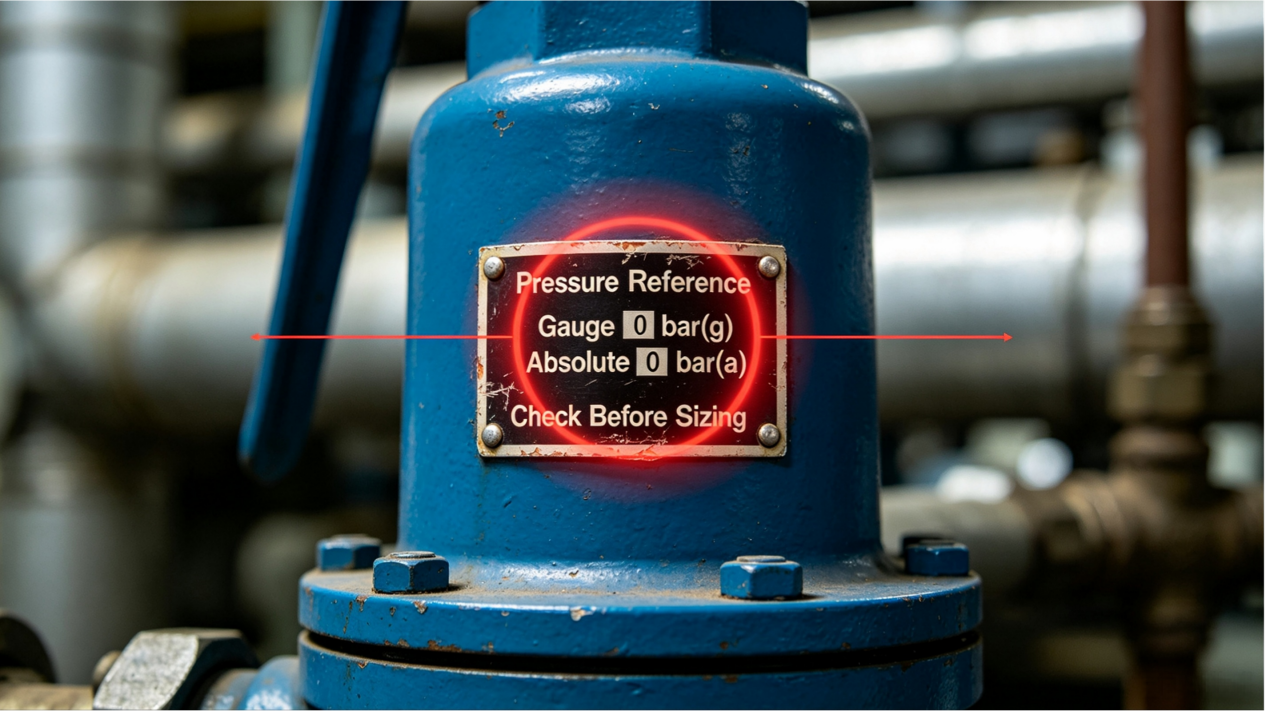
⚠️ Pitfall 1: Confusing G (Gauge) and A (Absolute) on Equipment Nameplates
Most users ignore the suffix mark when purchasing PSVs, safety valves, and pressure transmitters, leading to parameter setting errors. This mistake also frequently appears for small‑size devices such as propane tank safety valve and pressure relief valve engine assemblies.
Core Rule: G = Gauge Pressure (standard for 99 % of industrial safety valve set pressures); A / abs = Absolute Pressure (only for professional thermodynamic vacuum calculation).
Risk Warning: Using an absolute pressure sensor (0–1 MPa) for steam line monitoring will cause a 0.1 MPa fixed deviation. When the actual pipeline gauge pressure reaches 0.9 MPa, the sensor will be over‑ranged, resulting in the main pressure relief valve failing to open normally or the rupture disc valve bursting abnormally.
⚠️ Pitfall 2: Using "kg" as Formal Pressure Unit
Although "kg" is commonly used in workshop oral communication, it is not an international standard unit. It is forbidden to use it in PSV test reports, technical submittals, and factory nameplates.
Standard Requirement: Uniformly use MPa, kPa, or kgf/cm² to meet ASME, API, and GB international audit standards and avoid project acceptance failures when working with pressure relief valve manufacturer and relief valves manufacturers.
⚠️ Pitfall 3: Ignoring the Stability Difference of Gauge/Absolute Pressure
Gauge pressure takes local atmospheric pressure as the reference, so the set pressure and reseat pressure of spring‑loaded safety valves and oil pressure control valve will not be affected by altitude and weather changes, with stable operation.
Absolute pressure data will fluctuate with atmospheric pressure changes, so it is not suitable for daily safety valve pressure setting and system operation monitoring.
⚠️ Pitfall 4: Incorrect psi Conversion for Imported ASME Valves
American‑made fire safe ball valve, pneumatic actuators, and supporting safety valves are all marked with psi units. Accurate conversion is critical for equipment matching:
- 100 psi ≈ 0.7 MPa ≈ 7 kg/cm²
- 150 psi ≈ 1.03 MPa ≈ 10.3 kg/cm² (typical ASME Class 150 rating)
5. Why Choose Xiazhao Valve as Your Pressure Relief Valve Manufacturer?
Xiazhao Valve is a leading pressure relief valve manufacturer and supplier serving the global oil & gas, petrochemical, power generation, and pharmaceutical industries. Our comprehensive product range covers full‑line pressure relief valves:
- Spring‑loaded safety valves (PSV) – For general overpressure protection
- Pilot‑operated safety valves – For high‑pressure, large‑diameter systems with variable backpressure
- Rupture disc valve (bursting discs) – For fast‑acting, corrosion‑resistant relief
- Fire safe ball valve – For flammable liquid storage and LNG terminals
- Oil pressure control valve – For hydraulic and lubrication systems
- Autoclave safety valve – For pharmaceutical and food‑grade sterilization processes
- Custom‑built propane tank safety valve & pressure relief valve engine components
All Xiazhao Valve products are designed, manufactured, and tested in accordance with ASME, API 520/526, ISO 4126, and GB/T 12241 standards. We offer full technical support—from pressure unit verification and set pressure calculation to on‑site commissioning.
Final Summary: Gauge vs Absolute – The Engineer's Rule of Thumb
✅ Absolute pressure compares to vacuum.
✅ Gauge pressure compares to atmospheric air.
✅ 1 MPa ≈ 10 kg/cm² ≈ 145 psi.
✅ When ordering a valve, look for the suffix: G = Gauge, A = Absolute.
✅ For PSV, safety valve, or rupture disc selection, always confirm the pressure reference with your pressure relief valve manufacturer.
Need help with pressure unit conversion or safety valve sizing for your next project?
📩 Contact Xiazhao Valve today – Our technical team provides free, professional support for your overpressure protection challenges, from initial selection to final installation.