EN
EN


Engineering Application Analysis of Pilot-Operated Safety Relief Valves for HC Hydrocarbon Gas Service
Abstract
Hydrocarbon gas (HC Gas) is a prevalent hazardous medium widely utilized in natural gas processing, petrochemical refining, and gas transmission industries, characterized by flammability, explosiveness, and stringent fugitive emission control requirements. Conventional spring-loaded safety relief valves fail to maintain consistently tight sealing and stable discharge performance under operating conditions featuring narrow pressure margins, high built-up backpressure, and large relief flow rates. As a reliable high-performance overpressure protection device, the pilot-operated safety relief valve (POSRV) is specially engineered for complex HC gas working scenarios. Taking field-verified engineering data from a Bintulu Additional Gas Sales Facility (BAGSF) project as the core case, this paper systematically elaborates the selection criteria, core technical advantages, applicable working scenarios, and standardized sizing specifications of pilot-operated safety relief valves for HC gas service. Complying with API 520 and ASME Section VIII international standards, this analysis delivers authoritative technical references for process engineers and senior procurement professionals engaged in global petrochemical projects.
1. Introduction
Overpressure protection serves as the critical final safety barrier for pressurized hydrocarbon gas process systems. Even minor internal leakage of safety valves can trigger continuous HC gas loss, elevate fire and explosion hazards, and result in non-compliance with global fugitive emission regulations.
Restricted by inherent mechanical limitations, spring-loaded safety relief valves are prone to noticeable seat leakage when operating pressure approaches the set pressure. Additionally, their discharge capacity and opening accuracy are highly susceptible to interference from downstream backpressure. In contrast, pilot-operated safety relief valves adopt a split structural design, separating pressure sensing and main valve actuation via an independent pilot control unit. This unique design delivers ultra-tight sealing performance, complete backpressure immunity, and stable high-flow relief capability, making POSRVs the optimal overpressure protection solution for complex and demanding HC gas operating conditions in petrochemical and natural gas facilities.
Based on authentic P&ID and process design data of the BAGSF backup pipeline protection pilot-operated safety relief valve (Drawing No. 05-BAGSF-B-1007-1), this article conducts in-depth engineering analysis and summarizes universal selection principles of POSRVs for hydrocarbon gas industrial applications.
2. Project Operating Conditions & Core Design Parameters
The pilot-operated safety relief valve is installed on the BAGSF Backup Line to ABF PSV, providing overpressure protection for the BIF process unit of the BAGSF gas processing plant. The full set of design parameters covering pressure, temperature, relief capacity, backpressure, and pilot structure is detailed below.
2.1 Pressure Conditions: Narrow Margin High-Pressure Operation
Parameter |
Numerical Value |
Engineering Illustration |
Equipment Design Pressure |
63.8 barg |
Matches the valve set pressure |
Minimum Normal Operating Pressure |
56.5 barg |
Long-term steady operating pressure |
Maximum Normal Operating Pressure |
61 barg |
Upper limit of routine operating pressure |
Valve Set Pressure |
63.8 barg |
Predetermined actuation pressure |
Allowable Overpressure Ratio |
10% |
Full relief activation pressure: 70.18 barg |
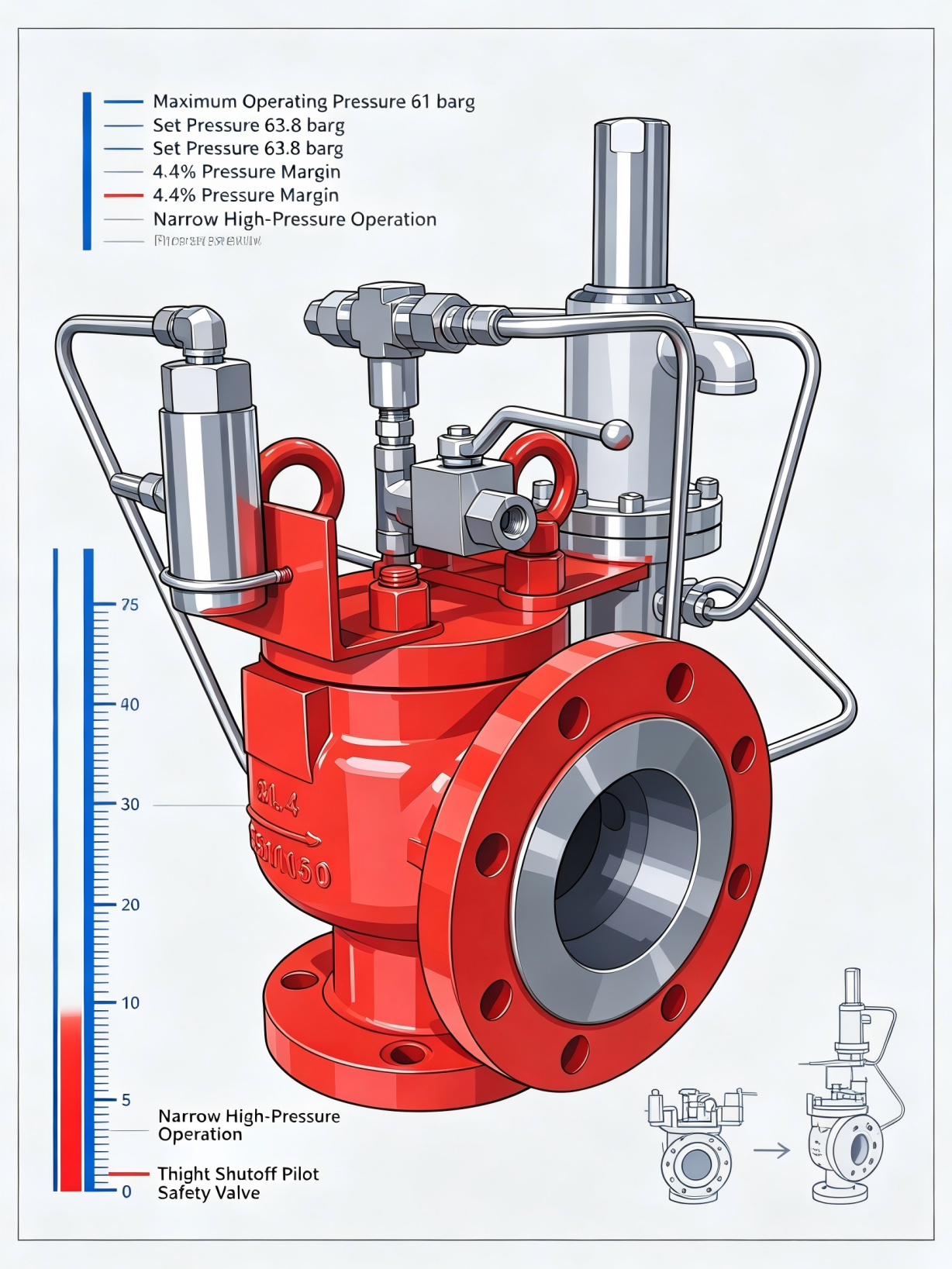
A key engineering feature of this working condition is the extremely narrow pressure margin: the gap between the maximum operating pressure and set pressure is only 2.8 barg, accounting for merely 4.4% of the set pressure. Under such narrow-margin high-pressure operating scenarios, spring-loaded valves generate persistent micro-leakage long before reaching their set pressure. By comparison, Xiazhao pilot-operated safety valves maintain zero visible leakage up to 97% of the set pressure, effectively eliminating HC gas escape risks and resolving the common sealing pain point of traditional safety valves during long-term continuous operation.
2.2 Temperature Design Envelope
- Continuous Operating Temperature: 28.48°C
- Maximum Design Temperature: 93°C
- Minimum Design Temperature: -20°C
This temperature range falls within mild medium-temperature service. A standard carbon steel valve body paired with stainless steel internal trim and fluoropolymer soft seals fully meets the requirements of anti-corrosion performance and low-temperature brittleness prevention for this project.
2.3 Relief Capacity Calculation & Orifice Sizing (Vapor Governing Case A)
All flow calculations strictly comply with the real gas sizing criteria specified in API 520 Part I for hydrocarbon vapor applications.
Sizing Index |
Technical Data |
Process Medium |
HC Hydrocarbon Gas Vapor |
Required Single-Valve Relief Capacity |
181,300 kg/h |
Gas Molecular Weight |
19.38 g/mol |
Compressibility Factor (Z) |
0.8305 |
Isentropic Specific Heat Ratio (k) |
1.200 |
Calculated Minimum Effective Orifice Area |
3,861 mm² |
Selected Standard Orifice Specification |
Orifice P, 4,932.248 mm² |
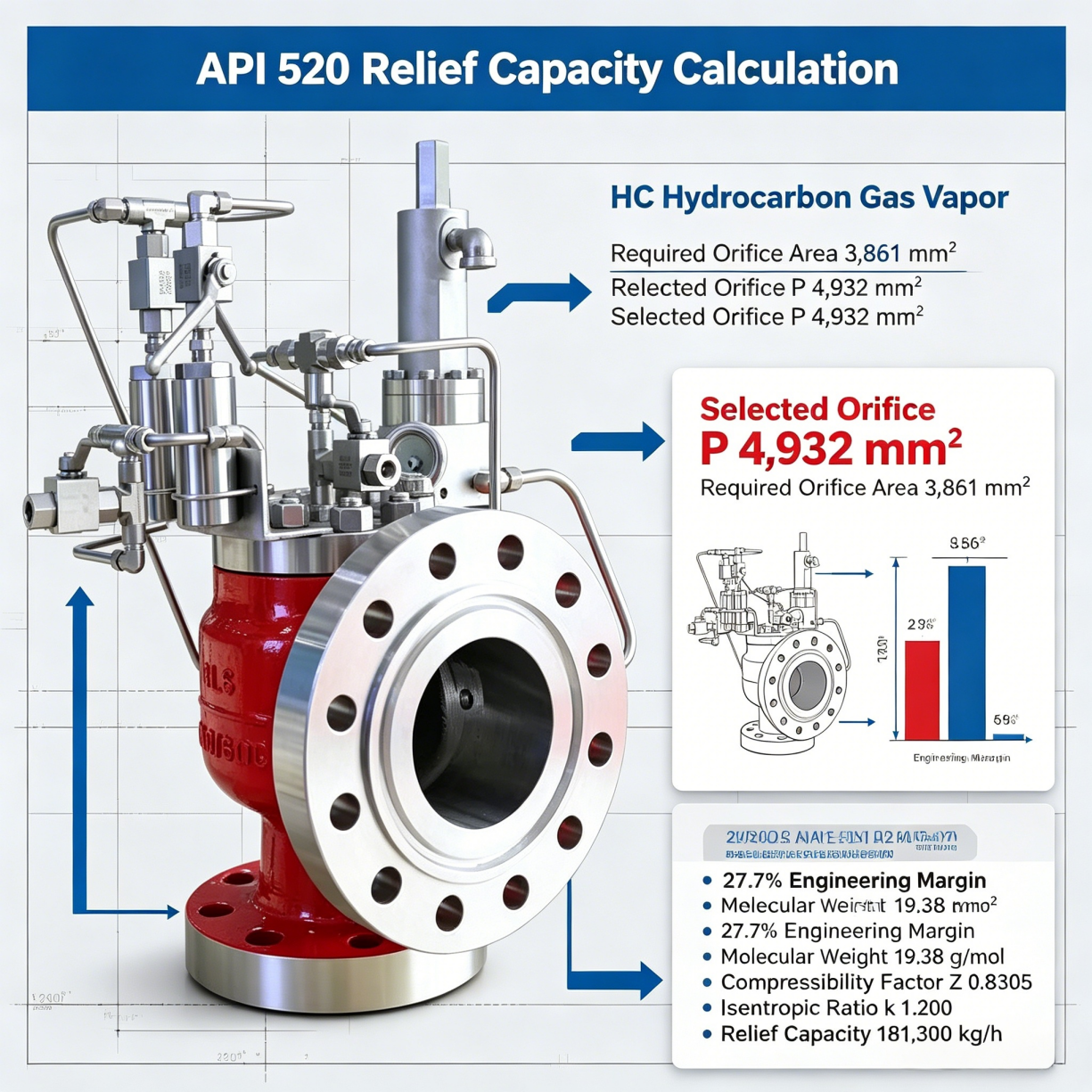
The actual selected orifice area exceeds the theoretical minimum requirement by 27.7%, reserving sufficient engineering safety margin to cope with unexpected pressure surges. Accurate sizing for HC gas vapor must incorporate molecular weight, compressibility factor, and adiabatic expansion coefficient, avoiding undersizing risks caused by ideal gas simplification.
2.4 Built-Up Backpressure Operating Condition
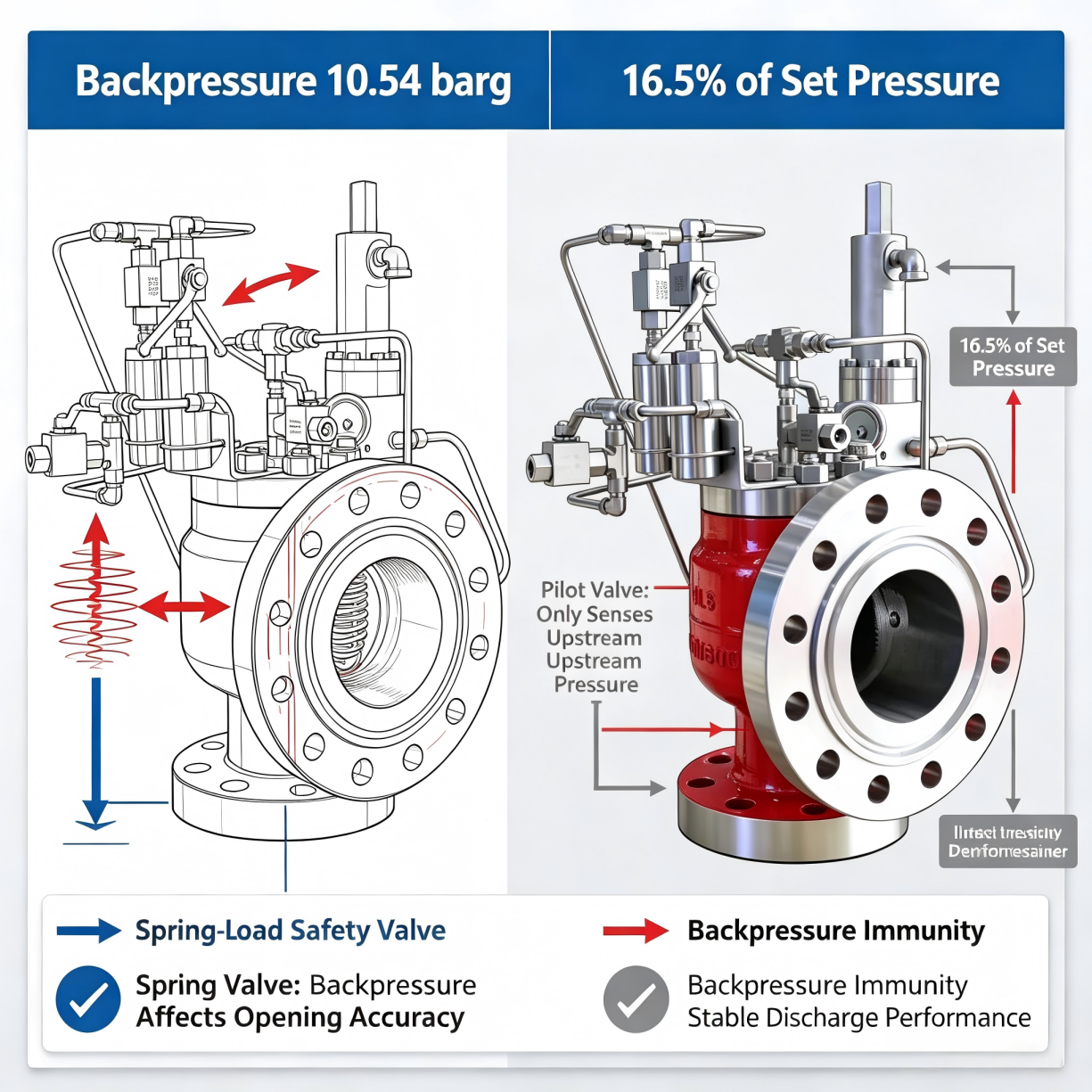
The total superimposed backpressure at the valve outlet is 10.54 barg, equivalent to 16.5% of the valve set pressure.
For conventional spring-loaded safety valves, downstream backpressure counteracts spring preload, resulting in shifted actual opening pressure and attenuated relief flow capacity. In contrast, the pilot control system of POSRVs only senses upstream process pressure and completely isolates downstream backpressure interference. Its opening precision and full-discharge performance remain stable regardless of backpressure fluctuations, which serves as the core rationale for adopting pilot-operated safety valves in this high-backpressure pipeline project.
2.5 Structural Configuration: Non-Flowing Pop-Action Pilot Design
The valve is configured with a pilot-operated pop-action non-flowing pilot structure, offering targeted advantages for HC gas medium service:
- Non-flowing pilot design: No continuous process medium circulates in the pilot chamber under normal operating conditions. This effectively prevents pilot passage blockage caused by solid impurities, heavy hydrocarbon condensate, and residual contaminants in raw natural gas.
- Pop-action opening characteristic: The valve achieves full instantaneous lift once the set pressure is reached, enabling rapid pressure evacuation during emergency overpressure events.
- High pressure sensing sensitivity: The pilot unit quickly responds to minor upstream pressure variations, preventing cumulative pressure build-up in process vessels and pipelines.
3. Core Technical Advantages of POSRVs for HC Gas Service
3.1 Ultra-Tight Sealing for Narrow-Margin High-Pressure Operation
With a mere 4.4% pressure margin between maximum operating pressure and set pressure, Xiazhao pilot-operated safety valves control leakage rates below 0.01 bubbles per minute before actuation, achieving industry-leading tight shutoff performance for HC gas service. In comparison, spring-loaded valves suffer from obvious fugitive leakage under identical working conditions. For flammable HC gas media, long-term micro-leakage leads to economic losses, potential safety hazards, and non-compliance with international fugitive emission standards.
3.2 Complete Immunity to Variable Backpressure
Whether facing stable static backpressure or fluctuating dynamic backpressure generated by parallel valve relief operations, the independent pilot pressure sensing unit of pilot-operated safety valves eliminates downstream pressure interference. It maintains negligible set pressure deviation and zero flow attenuation, making this high backpressure resistant safety valve ideal for complex vent header systems widely used in gas processing plants.
3.3 Superior High-Flow Relief Performance
Featuring a piston-type main valve structure, POSRVs provide a larger effective discharge area than spring-loaded alternatives with the same nominal inlet size, delivering superior high-flow relief performance for large-capacity HC gas systems. For the high-flow demand of 181,300 kg/h HC gas vapor in this project, the standard P-orifice pilot-operated safety valve fully meets the sizing requirement without oversized valve bodies or complex multi-valve parallel configurations.
3.4 Customizable Corrosion and Erosion Resistance
Suitable for sour gas, wet hydrocarbon, and corrosive industrial environments, Xiazhao Valve supports customized internal trim materials (316L stainless steel, Monel, Hastelloy) and premium anti-corrosion coating systems. Classified as a C3 moderate industrial corrosion environment, the BAGSF project adopts heavy-duty epoxy external coating and stainless steel wetted parts to extend the valve’s service life and ensure long-term reliable operation.
4. Typical Industrial Application Scenarios
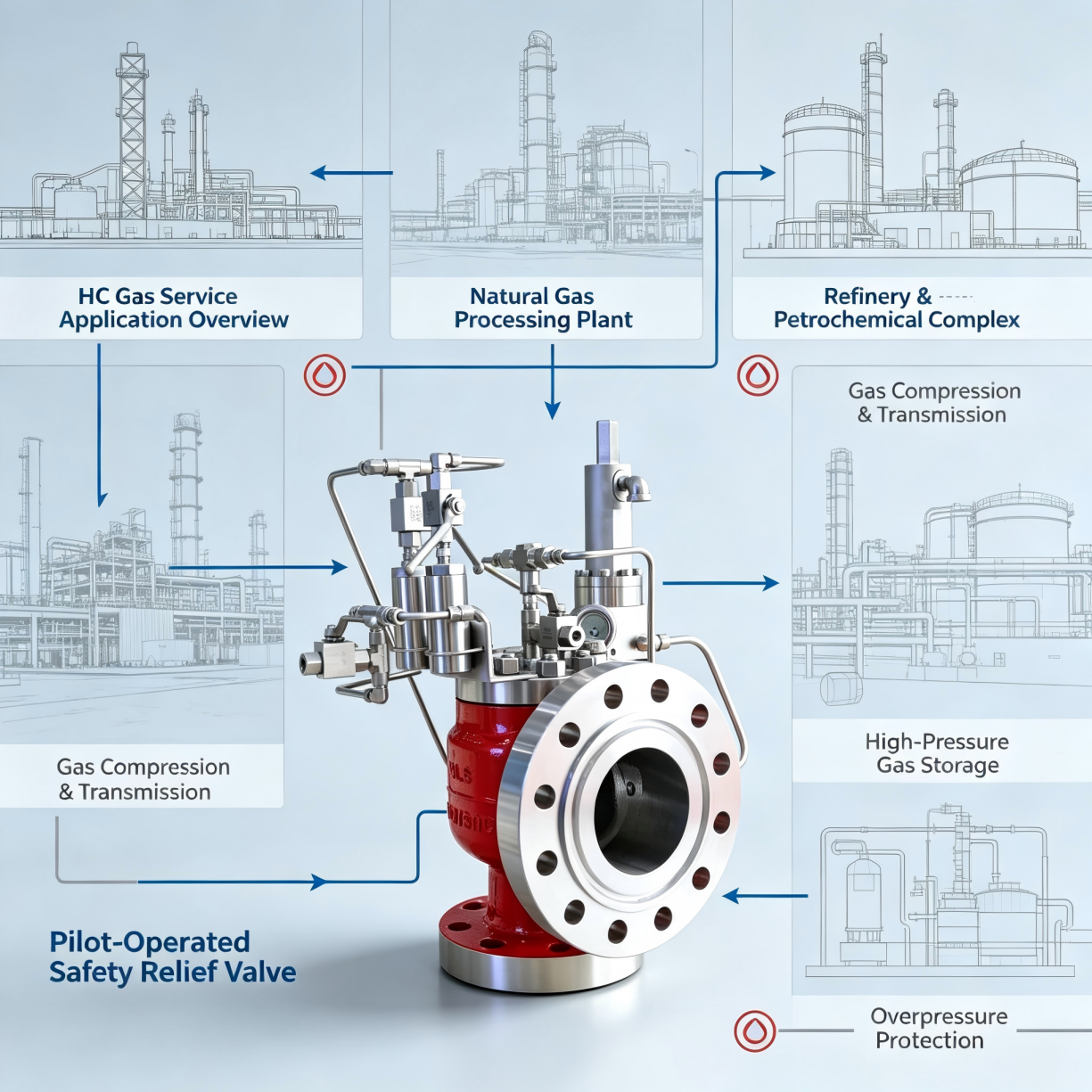
Validated by the BAGSF engineering case, POSRVs are the preferred overpressure protection solution for all hydrocarbon gas processing facilities, covering the following core scenarios:
4.1 Natural Gas Processing Plants
Pilot-operated safety valves are widely applied in natural gas plant dehydration, amine desulfurization, fractionation units, and compressor stations. The non-blocking non-flowing pilot structure and stable sealing performance adapt perfectly to unpurified raw natural gas media and harsh gas processing operating conditions.
4.2 Refinery & Petrochemical Complexes
In refinery and petrochemical complexes, high-performance POSRVs serve as critical petrochemical safety valves for overpressure protection of HC gas product pipelines, reactor outlets, and buffer tanks in catalytic cracking, hydrotreating, reforming, and distillation process units.
4.3 Gas Compression & Transmission Systems
Ideal for suction and discharge pipelines of reciprocating and centrifugal compressors, long-distance gas transmission trunk lines, and station bypass backup pipelines, catering to high-pressure and large-flow relief demands.
4.4 High-Pressure HC Gas Storage Facilities
Optimized for pressure vessel storage systems with design pressures above 50 barg, where zero-leakage long-term operation is mandatory due to narrow operating-set pressure margins.
5. Critical Sizing & Selection Checklist for HC Gas POSRVs
Key Design Parameter |
Project Reference Value |
Engineering Selection Significance |
Set Pressure |
63.8 barg |
Defines valve pressure class, flange rating and material temperature rating |
Continuous Operating Temperature |
28.48°C |
Determines trim alloy and soft seal elastomer selection |
Required Relief Capacity |
181,300 kg/h |
Specifies standard orifice size and nominal valve dimension |
Gas Molecular Weight |
19.38 g/mol |
Core input for API-compliant real vapor flow calculation |
Compressibility Factor (Z) |
0.8305 |
Corrects deviation between real gas and ideal gas flow formulas |
Isentropic Specific Heat Ratio (k) |
1.200 |
Identifies critical/subcritical flow regime for accurate sizing |
Total Built-Up Backpressure |
10.54 barg |
Key indicator for selecting pilot-operated design over spring-loaded valves |
Allowable Overpressure |
10% |
Defines full-lift relief pressure and valve stroke characteristics |
Selected Orifice Area |
4,932 mm² (Orifice P) |
Finalizes overall valve structural dimensions |
Environmental Corrosion Class |
C3 |
Guides external coating, fastener and anti-corrosion trim design |
All pilot-operated safety valve sizing, material selection and design specifications strictly comply with global industry standards including API 520, API 526 and ASME Section VIII Div.1, ensuring standardized and reliable overpressure protection for all HC gas service scenarios.
6. Conclusion
For HC gas working conditions featuring narrow pressure margins, high backpressure, and large relief flow rates, pilot-operated safety relief valves deliver far superior performance to conventional spring-loaded valves in sealing tightness, actuation stability, and discharge capacity. The field data from the BAGSF project fully demonstrates the irreplaceable engineering advantages of POSRVs as professional HC gas pressure relief valves in hydrocarbon gas severe service.
Widely applicable to natural gas processing, petroleum refining, petrochemical manufacturing, and long-distance gas transmission industries, precisely specified POSRVs effectively reduce fugitive emissions, minimize medium loss, and ensure stable long-cycle operation of process plants, serving as essential safety equipment for pressurized HC gas systems.
Shanghai Xiazhao Valve focuses on the R&D and customization of pilot-operated safety relief valves for hydrocarbon gas, sour media, and high-backpressure severe working conditions. We provide global process engineers and senior procurement managers with full-cycle professional technical services, including process condition evaluation, API 520 standard sizing calculation, customized material matching, and on-site installation guidance, delivering tailored safety valve solutions for diverse gas and petrochemical projects.
Disclaimer: All data in this article is sourced from actual overseas gas plant engineering projects for technical reference only. Final valve selection, sizing and design must be verified in accordance with clients’ official design basis documents.
SEO Core Keywords: pilot operated safety relief valve, POSRV for hydrocarbon gas, HC gas pressure relief valve, API 520 safety valve sizing, high backpressure safety valve, tight shutoff pilot safety valve, natural gas plant overpressure protection, petrochemical safety valve, spring vs pilot safety valve fugitive emission