EN

Set Pressure Tolerance, Overpressure Margin and CDTP: What Your API 526 Purchase Order Should Fix in Writing
Shanghai Xiazhao Valve · Technical note for process engineers and procurement
Two safety relief valves, both stamped "set at 100 barg", can sit on different pressure ladders. One opens at 98 and reseats at 88; the other opens at 102 and closes at 92. In a bid comparison nobody is lying about "set pressure" — they are quoting different points on that ladder. This article lists the numbers a purchase order has to fix in writing, because the standards assume them and vendor shorthand hides them.
1. The pressure ladder, in one picture
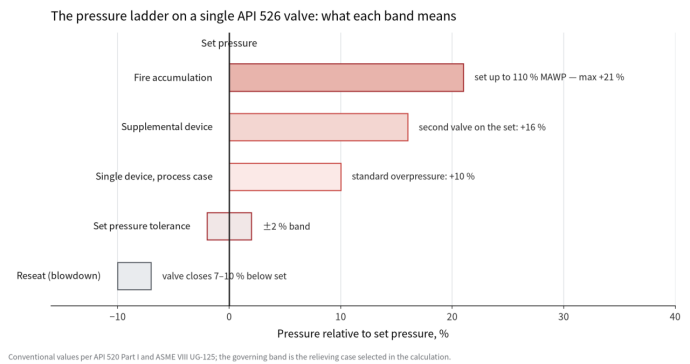
Set pressure is the pressure at which the valve first opens — but a relieving event is judged against four other values around it: the popping tolerance band, the overpressure allowed at certified capacity, the accumulation permitted above MAWP, and the blowdown at which the valve reseats. Mixing them up is the most common cause of "the valve opened too early" disputes after installation.
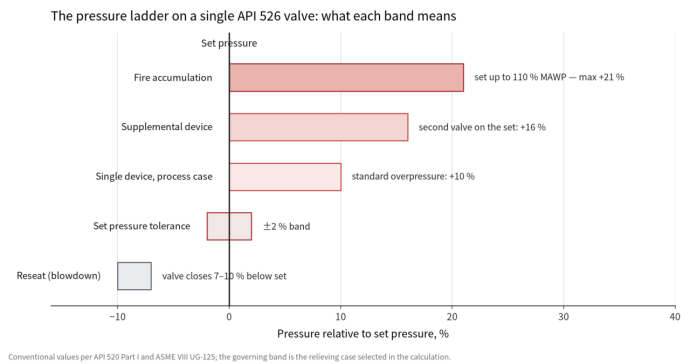
Figure 1. The pressure ladder on a single API 526 valve: popping tolerance, overpressure, accumulation and blowdown sit at different points relative to set.
2. Set-point tolerance is not a flat percentage
Popping tolerance follows a step, not a line. Above 70 psig (4.8 barg) the accepted band is ±2% of set pressure. At or below 70 psig it is a fixed ±3 psi (0.2 bar), because a fixed 2% on a 30 psi set point would be unmeasurably small on the test stand. Ask for the measured pop pressure on the certificate, not the marketing line "set per PO".
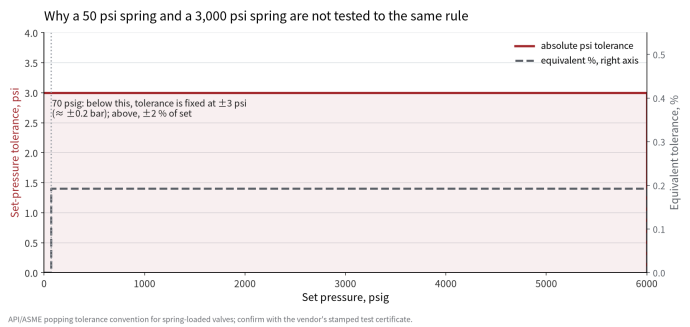
Figure 2. Set-pressure tolerance: ±3 psi below 70 psig, ±2% above. The absolute tolerance band narrows as set pressure drops.
3. Overpressure and accumulation are not the same number
Overpressure is pressure rise above set pressure at rated flow. Accumulation is pressure rise above MAWP across the system. They differ by how many valves are relieving and why:
Relieving case |
Permitted accumulation above MAWP |
Maximum set pressure |
Single device, process upset |
10% |
100% of MAWP |
Second / supplemental device on the same set |
16% |
105% of MAWP |
External fire case |
21% |
110% of MAWP |
The sizing calculation uses whichever case governs. A valve sized for 10% overpressure on the process case cannot be moved to the fire case and still claim certified capacity — the rating was proven at a different accumulation.
4. Blowdown: too tight is as bad as too loose
Blowdown is the pressure drop between pop and reseat. Standard spring valves commonly reseat 7–10% below set; adjustable blowdown rings or screws widen the band on request. Specify it too tight — reseating within 2% of set on a spring valve — and the valve does not get to full lift, discharge becomes unstable, and chattering starts. Chatter, not leakage, is the failure that actually destroys seat faces. A workable PO line reads: "reseat within 10% of set pressure, minimum 2 bar below set."
5. CDTP: the number nobody prints on the nameplate
Balanced-bellows valves are set on the shop stand against atmospheric backpressure. In service, a flare header keeps constant backpressure on the outlet, so the spring preload is set differently: the cold differential test pressure (CDTP) equals set pressure minus the maximum expected superimposed backpressure. Example: set pressure 100 barg, superimposed backpressure 10 barg → the valve is cold-tested at 90 barg. If the buyer never states the expected backpressure, the vendor defaults to atmospheric, and the valve drifts off set the day the header goes on line.
6. Five lines worth writing into the purchase order
- Set pressure and the test medium (air / steam / water) for the set.
- Accepted popping tolerance — default ±2% above 70 psig, ±3 psi below.
- The governing relieving case and permitted accumulation (10 / 16 / 21%).
- Required blowdown band, not just "standard".
- For balanced-bellows valves: maximum superimposed backpressure and resulting CDTP.
7. A worked example: 100 barg set, 10 barg superimposed backpressure
Put the numbers together. A conventional valve sitting on a header that holds 10 barg constant starts opening around 110 barg effective — 10% above nominal set, already outside the ±2% tolerance, before the process ever overpressures. The same duty with a balanced bellows: the factory cold-tests it at 90 barg CDTP, the valve opens at 100 barg in service, and built-up backpressure at rated flow is checked against the 10% line. The purchase order then reads: set 100 barg ±2%, CDTP 90 barg, blowdown 90–93 barg, accumulation allowed 10%. No ambiguity left for the shop, the auditor, or the site startup team.
Shanghai Xiazhao Valve supplies API 526 flanged steel pressure relief valves tested with set pressure, pop tolerance, blowdown and CDTP documented on the certificate. Send your MAWP, relieving case and expected backpressure for a specification check.
Keywords: API 526 safety valve, set pressure tolerance, overpressure accumulation, CDTP cold differential test pressure, blowdown pressure relief valve, PSV procurement, API 520 Part I
Table of Contents
- Set Pressure Tolerance, Overpressure Margin and CDTP: What Your API 526 Purchase Order Should Fix in Writing
- 1. The pressure ladder, in one picture
- 2. Set-point tolerance is not a flat percentage
- 3. Overpressure and accumulation are not the same number
- 4. Blowdown: too tight is as bad as too loose
- 5. CDTP: the number nobody prints on the nameplate
- 6. Five lines worth writing into the purchase order
- 7. A worked example: 100 barg set, 10 barg superimposed backpressure