EN
Severe-Service Metallurgy Matrix & Balanced Bellows (Type TOBS) Back-Pressure Immunity Architecture
Published by Technical Engineering Department, Shanghai Xiazhao Valve Co., Ltd.
Target Keywords: NACE MR0175 Safety Valve, Balanced Bellows Safety Relief Valve, TOBS Bellows Valve, Chrome Moly WC9 Safety Valve, Inconel 625 Bellows
1. Introduction: Metallurgy as the Determinant of Pressure Boundary Safety
In oil refining hydrotreating units, catalytic crackers, sour gas amine scrubbers, and severe chemical synthesis plants, safety relief valves operate at the dangerous intersection of **elevated temperatures (up to 538°C), high pressure (ASME Class 600–1500), corrosive hydrogen sulfide (H₂S), and pulsating flare stack back pressures**.
Under these combined chemical and mechanical stresses, standard carbon or generic 316 stainless steel valves succumb to catastrophic failure mechanisms:
- Sulfide Stress Cracking (SSC) & Hydrogen Embrittlement: Atomic hydrogen diffusing into hardened steel matrices triggers instantaneous brittle fracture of valve stems and guide pins.
- High-Temperature Sulfidation & Creep Rupture: Standard carbon steel bodies lose structural tensile strength rapidly above 427°C (800°F).
- Back-Pressure Induced Popping Failures: In complex flare systems, fluctuating back pressure acts directly on the back of standard valve discs, altering popping set-points and throttling relieving capacity by up to 50%.
CORROSION & BACK-PRESSURE MECHANISMS IN SAFETY VALVES
=====================================================
Conventional Conventional Valve (Unbalanced):
[Variable Flare Header Back Pressure] --- [Acts on Disc Top Area] --- [Set Pressure Shifts Arbitrarily]
[Sour H2S / Wet Gas Medium] ------------- [Direct Contact with Spring] - [Rapid Spring Embrittlement & Failure]
Balanced Bellows Safety Valve (Xiazhao Type TOBS):
[Variable Flare Back Pressure] === [Multi-Ply Bellows Cancels Force] == [Rock-Solid Stable Set Pressure]
[Sour H2S / Corrosive Fluid] ===== [Hermetically Isolated from Spring] - [Inconel 625 Bellows Zero Ingress]
2. Severe-Service Metallurgy Matrix: Matching Alloys to Hostile Process Streams
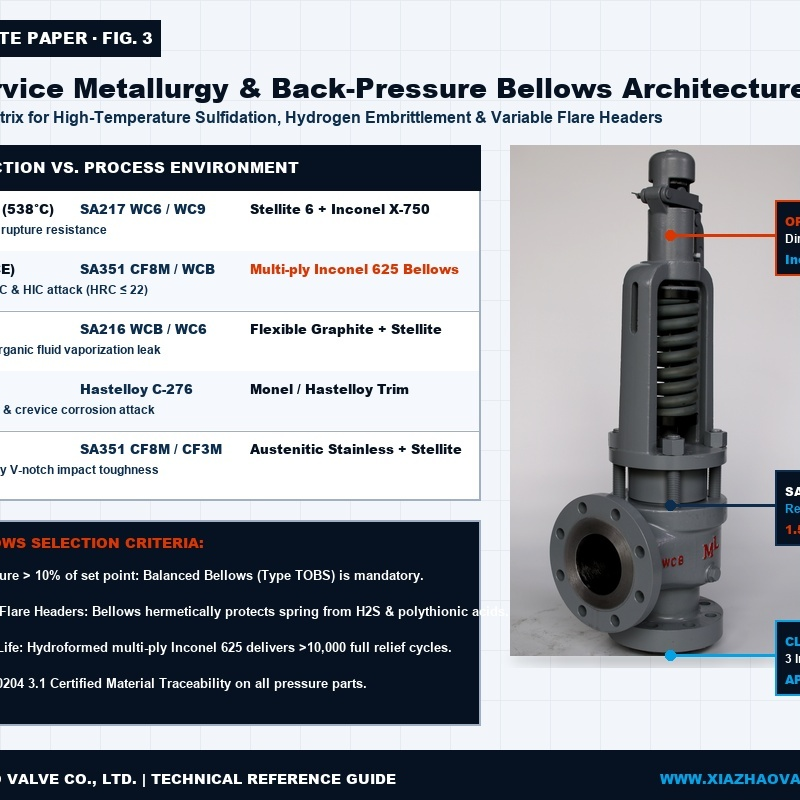
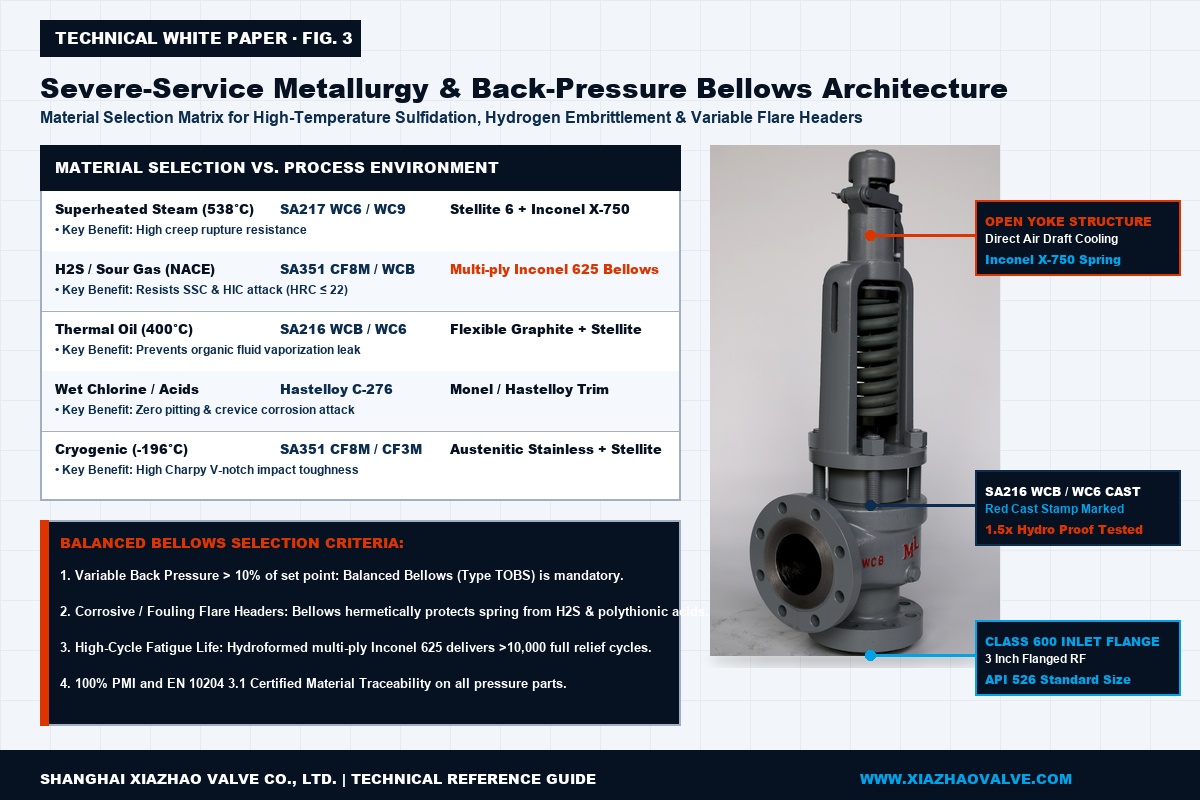
Selecting the correct alloy for every internal and external component is essential to guarantee mechanical compliance with "ASME Section VIII Division 1 " and "NACE MR0175 / ISO 15156 ".
| COMPREHENSIVE SEVERE-SERVICE METALLURGY MATRIX: XIAZHAO SERIES TOS / TOBS VALVES | |||
| Component | Standard Steam / Air Service | Sour Gas Service (NACE MR0175) | High-Temp Alloy (427℃) |
| Valve Body & Bonnet | ASME SA216 Gr. WCB (Carbon) | ASME SA351 Gr. CF8M / WCB | ASME SA217 Gr. WC6 / WC9 |
| Solid Nozzle Seat | 316 Stainless + Stellite 6 | 316L SS + Stellite Gr. 6 | Inconel 625 + Stellite 6 |
| Relieving Disc | 316 Stainless + Stellite 6 | 316L SS + Stellite Gr. 6 | Inconel 718 + Stellite 6 |
| Balanced Bellows (TOBS) | / (Open Spring Cavity) | Multi-ply Inconel 625 / 316L | Multi-ply Inconel 625 |
| Valve Spring | Alloy Steel (Coated) | Coated Alloy / Inconel X-750 | Inconel X-750 Superalloy |
| Spindle / Guide Bushing | ASTM A276 Type 420 / 316 | 316 Stainless Treated | Nitrided Stellite Alloy |
| Bonnet Studs & Nuts | SA193 Gr. B7 / SA194 Gr. 2H | SA193 Gr. B8M / SA194 Gr. 8M | SA193 Gr. B16 / SA194 Gr.4 |
2.1 Chrome-Molybdenum Steels (SA217 WC6 & WC9) for High-Temperature Creep
Above 427°C (800°F), carbon steel undergoes carbide spheroidization and graphitization, causing severe loss of creep strength. Xiazhao specifies "ASME SA217 Grade WC6 (1.25% Cr - 0.5% Mo) " and "Grade WC9 (2.25% Cr - 1% Mo) " alloy castings for services up to "538°C (1000°F) ". Molybdenum reinforces creep rupture strength, while chromium provides critical oxidation and sulfidation barrier resistance.
2.2 NACE MR0175 / ISO 15156 Sour Gas Hardness Compliance
For sour oil and gas processing containing hydrogen sulfide ($H_2S$), all metallic components undergo strictly controlled heat treatment to ensure maximum Rockwell hardness values remain strictly below "22 HRC (250 HV) "per NACE MR0175 limits, completely eliminating sulfide stress corrosion cracking.
3. Balanced Bellows Architecture (Series TOBS): Solving the Variable Back-Pressure Challenge
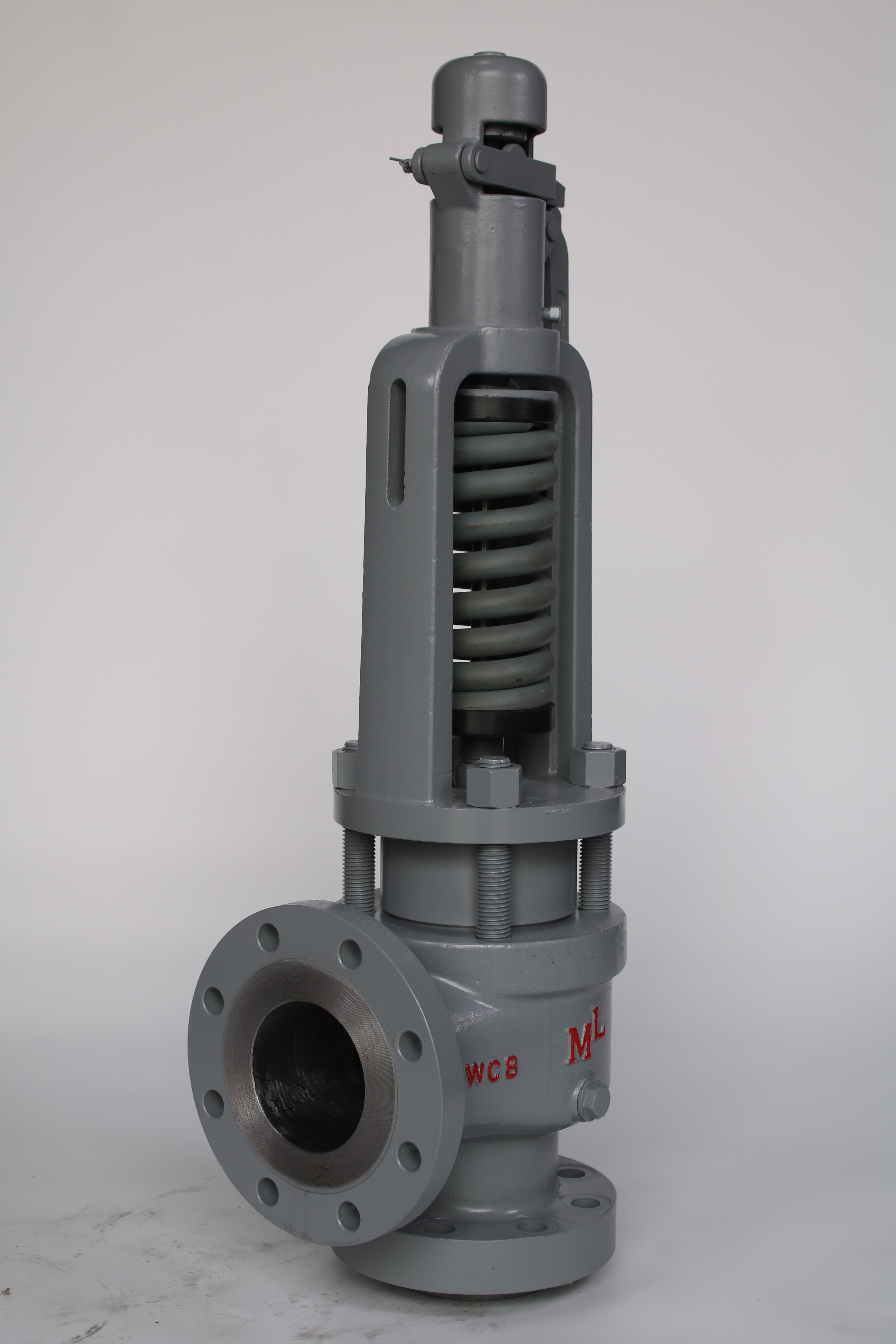
Real Product Photo: ASME SA216 WCB / WC6 High-Integrity Pressure Shell with 100% Traceable Casting Heat Marks
In industrial flare systems, multiple process units relieve into a shared header manifold. When an upstream unit discharges, back pressure in the header spikes unpredictably.
3.1 The Working Principle of Type TOBS Balanced Bellows
In a conventional valve, back pressure exerts an unbalancing downward force on the back of the disc holder, artificially increasing the effective popping pressure ($P_{pop} = P_{set} + P_{back}$).
The "Shanghai Xiazhao TOBS Balanced Bellows Safety Relief Valve " incorporates a "hydroformed multi-ply Inconel 625 or 316L bellows ":
1. The effective cross-sectional area of the bellows is precision-machined to **exactly match the nozzle seat sealing area ($A_{bellows} = A_{seat}$)**.
2. Back pressure forces acting upward and downward cancel out instantaneously, maintaining **100% set pressure stability even with variable back pressure reaching 40% to 50% of set point**.
3. The bellows provides a hermetic barrier, completely sealing the spring, spindle, and guide bushing from corrosive, foul, or toxic flare gases.
4. Factory Quality Assurance & Certified NDE Inspection
Every severe-service safety valve manufactured by Shanghai Xiazhao undergoes certified non-destructive examination (NDE) and performance validation prior to shipment:
- 100% Positive Material Identification (PMI) on all alloy castings, forgings, and weld hardfacings.
- Hydrostatic Shell Proof Testing conducted to
- API 527 Bubble-Tight Seat Testing conducted using high-purity nitrogen/helium with zero allowable bubble leakage.
- Certified EN 10204 Type 3.1 Material Test Reports (MTRs) provided with full heat number traceability.
For severe-service material recommendations, sour gas compliance audits, and balanced bellows safety relief valve sizing, contact Shanghai Xiazhao Valve Co., Ltd.
Table of Contents
- 1. Introduction: Metallurgy as the Determinant of Pressure Boundary Safety
- 2. Severe-Service Metallurgy Matrix: Matching Alloys to Hostile Process Streams
- 3. Balanced Bellows Architecture (Series TOBS): Solving the Variable Back-Pressure Challenge
- 4. Factory Quality Assurance & Certified NDE Inspection