EN

 400°C)">
Thermal Decoupling & Chimney Draft in Open Bonnet Safety Valves (Xiazhao Type 4N8 vs. Enclosed Bonnet)
Published by Technical Engineering Department, Shanghai Xiazhao Valve Co., Ltd.
Target Keywords: High Temperature Safety Valve, Spring Relaxation, Open Bonnet Safety Relief Valve, API 526 Steam Safety Valve, Stellite Hardfacing
1. The High-Temperature Dilemma: Why Standard Enclosed Safety Valves Fail
In high-pressure boiler headers, steam turbine bypass stations, and thermal power facilities operating between "400°C and 538°C (750°F to 1000°F) ", safety relief valves (SRVs) are the final defense against catastrophic overpressure. However, maintenance logs across global power utilities consistently reveal an alarming pattern: standard enclosed-bonnet safety relief valves often begin simmering, leaking, or drifting off-calibration within merely 3 to 6 months of commissioning.
The financial and operational consequences are severe:
- Costly Continuous Steam Loss: A persistent 1.5 mm micro-leak on a 10.0 MPa (1450 psig) superheated steam line squanders over
- Premature Set-Pressure Drift: Exposure to sustained heat lowers the spring’s shear modulus ($G$), causing the valve to pop prematurely below normal operating pressure and triggering uncommanded plant trips.
- Catastrophic Seat Wire-Drawing: High-velocity steam channeling across compromised seating surfaces cuts deep grooves into conventional stainless steel discs, rendering the valve un-reseatable.
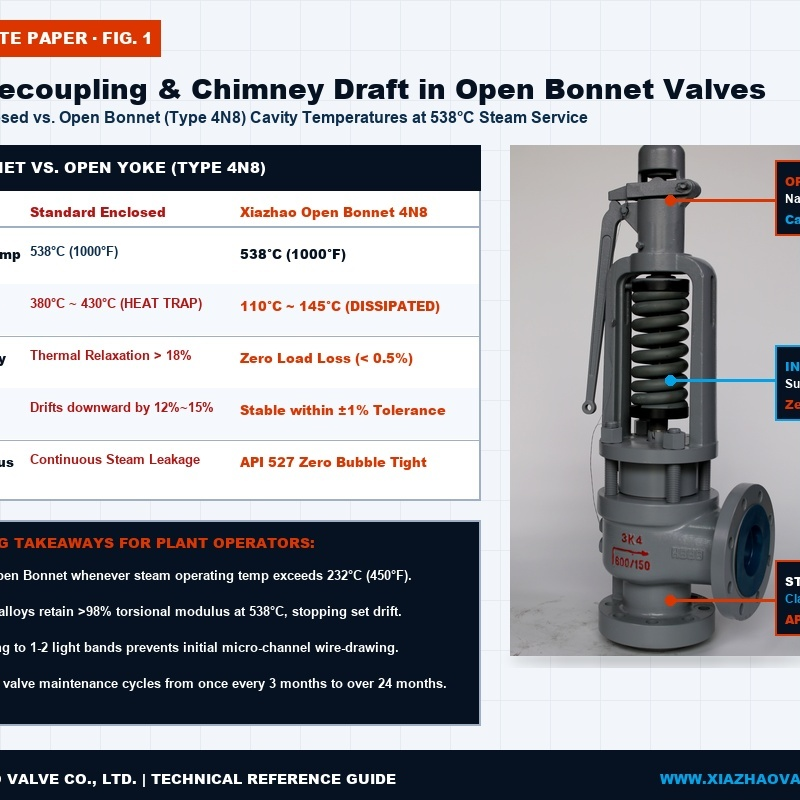
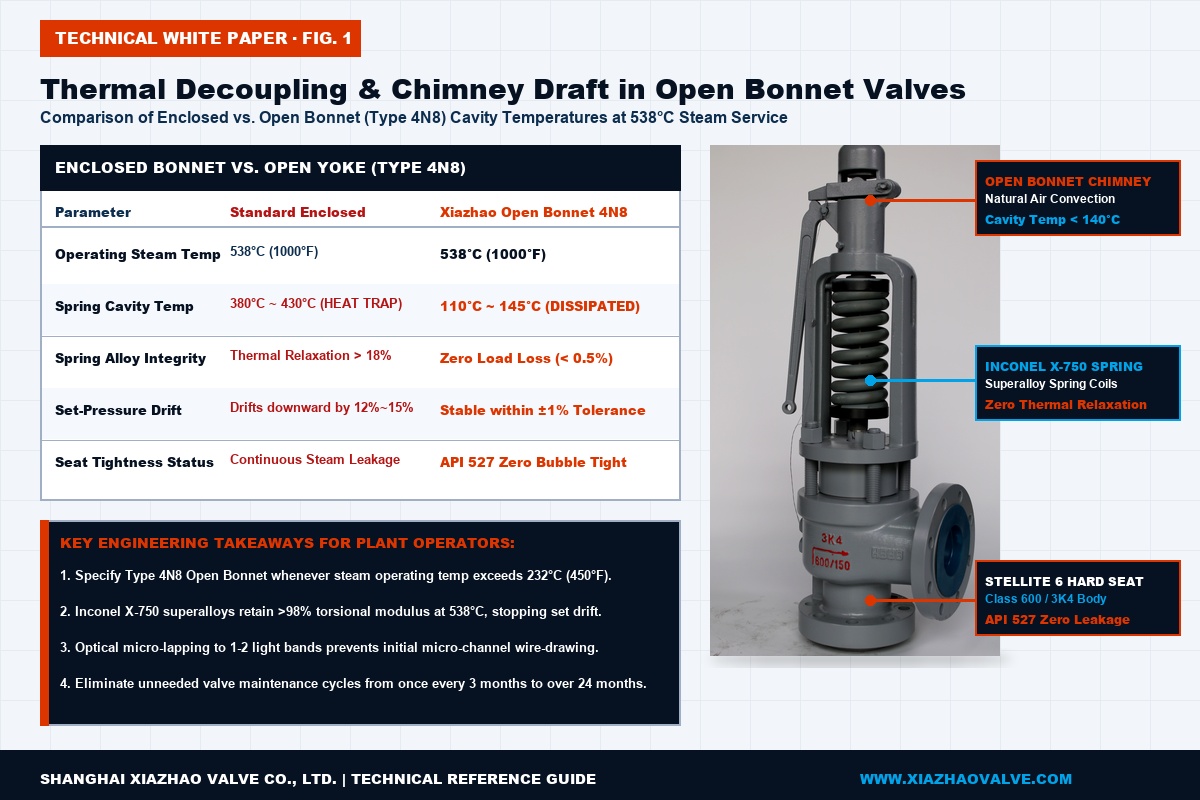
HEAT BUILD-UP PATHWAY IN ENCLOSED VS. OPEN BONNET VALVES
Enclosed Bonnet (Standard):
[538°C Steam] --- [Body Cavity] --- [Trapped Bonnet Air: 380°C~430°C] --- [Spring Relaxation 18%]
(Premature Pop & Leakage)
Open Yoke Chimney Bonnet (Xiazhao Type 4N8):
[538°C Steam] --- [Body Cavity] === [Natural Air Chimney Draft] ====== [Spring Cavity: <140°C]
(Zero Load Loss / Stable Set Point)
2. Root Cause Analysis: Thermal Physics Inside the Spring Cavity
2.1 The Critical Role of Spring Relaxation
All spring steels experience thermal creep under sustained torsional stress. When an enclosed bonnet safety valve is mounted on a 500°C steam pipe, radiant and conductive heat rapidly elevates internal bonnet temperatures to "380°C–430°C ". Under these conditions:
1. Standard alloy spring steel (such as Chrome-Vanadium AISI 6150) loses over "15% to 22% of its initial pre-load force " due to metallurgical relaxation.
2. The downward seating force ($F_s = k \cdot \Delta x$) drops significantly below the upward system pressure force ($F_p = P \cdot A_{seat}$).
3. The margin between operating pressure and set pressure closes, leading to continuous simmering and audible chatter.
2.2 Microscopic Seating Distortions
As thermal gradients warp the disc holder and guide bushing, contact pressure across the seat becomes non-uniform. Microscopic steam pathways form, causing localized high-velocity erosion (wire-drawing).
3. Engineering Solutions: Xiazhao High-Temperature Design Architecture
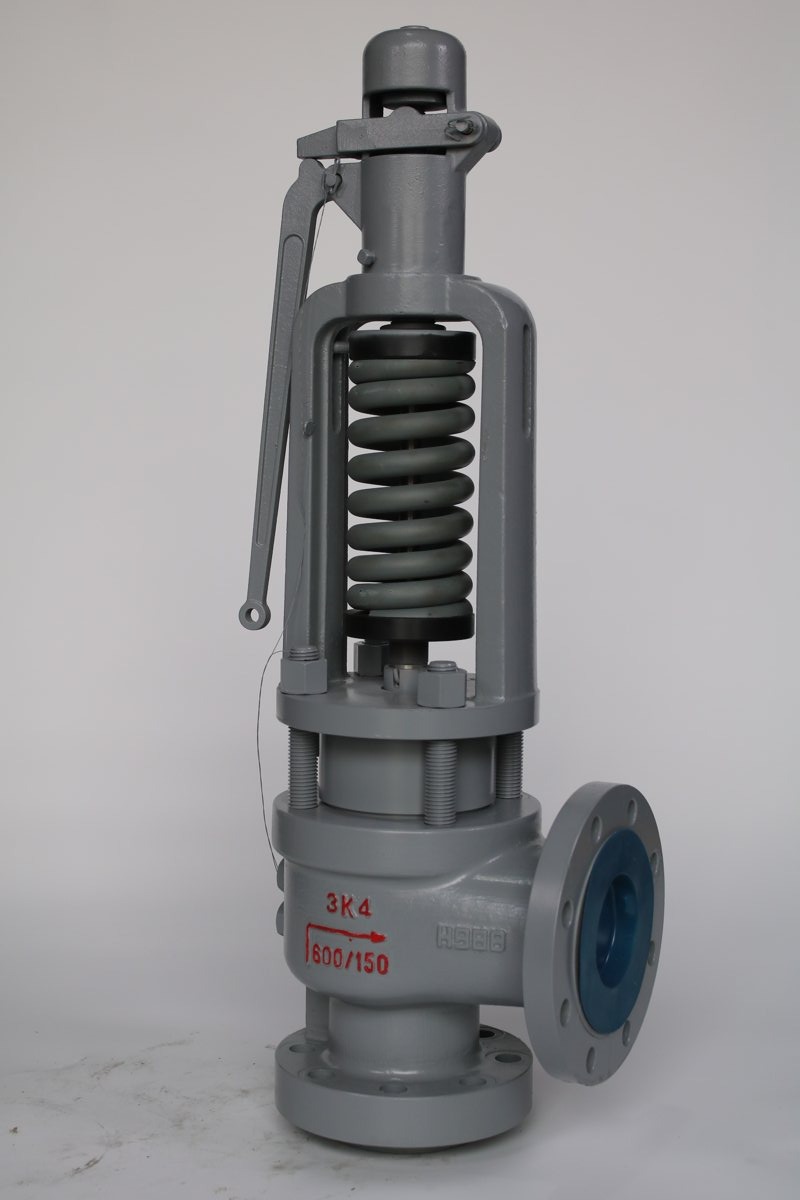
Real Product Photo: Shanghai Xiazhao 3K4 ASME Class 600 High-Temperature Safety Valve with Open Yoke Chimney
To permanently resolve thermal degradation, the "Shanghai Xiazhao TOS Series High-Temperature Safety Relief Valve (API 526 Class 600 / 3K4 & 3K6) " incorporates three mission-critical design features:
| KEY ENGINEERING SPECIFICATIONS: XIAZHAO HIGH-TEMP STEAM RELIEF VALVE | ||
|---|---|---|
| Parameter | Conventional Enclosed Valve | Xiazhao TOS-06 (3K4 Open Yoke) |
| Operating Temperature Limit | ≤ 232℃ (450°F) | Up to +538℃ (+1000°F) |
| Bonnet Architecture | Closed Cast Bonnet | Open Yoke Chimney (Type 4N8) |
| Spring Cavity Temperature | 380℃ ~ 430℃ (Heat Trapped) | 110℃ ~ 145℃ (Heat Dissipated) |
| Spring Metallurgy | Standard Alloy Steel (AISI 6150) | Inconel X-750 Superalloy |
| Seating Surface Hardfacing | Standard 316 / 410 Stainless Steel | Solid Stellite 6. Deposition |
| Lapping Flatness Tolerance | 4 ~ 6 Light Bands | 1 ~ 2 Monochromatic Light Bands |
| API 527 Bubble Leakage Rate | 20 Bubbles/min after 3 months | 0 Bubbles (Bubble-Tight Seal) |
3.1 Open Yoke Natural Convection Chimney (Cap Type 4N8)
By replacing the closed bonnet with an "engineered open-yoke structure (Type 4N8) ", ambient air naturally circulates around the spring via thermal buoyancy. Heat transferred from the body neck is rejected to atmosphere before reaching the spring washers. Empirical thermal imaging confirms that when the valve body operates at 538°C, the spring cavity remains below "140°C (284°F) ".
3.2 Inconel X-750 Superalloy Spring Metallurgy
For temperatures exceeding 427°C, Xiazhao equips safety valves with "Inconel X-750 precipitation-hardened nickel-chromium alloy springs ". Inconel X-750 exhibits exceptional resistance to relaxation and creep, maintaining over "98.5% of its initial spring rate " across 10,000+ thermal hours.
3.3 Stellite Cobalt-Base Hardfacing with Optical Micro-Lapping
Both the solid screw-in nozzle and disc are deposited with heavy "Stellite Cobalt Alloy (Grade 6) " hardfacing (minimum 2.5 mm thickness, 40–45 HRC at elevated temperatures). Surfaces undergo multi-stage diamond grinding and optical micro-lapping to "1–2 monochromatic helium light bands (0.3–0.6 µm flatness) ", completely eliminating wire-drawing vulnerabilities.
4. Field Installation Best Practices & Maintenance Checklist
To achieve a 5+ year maintenance-free lifecycle on high-temperature steam lines, adhere to the following ASME Section VIII guidelines:
Insulation Boundary: Never insulate the bonnet or spring cavity of an open-yoke safety valve. Only insulate the inlet nozzle and valve body up to the lower body flange.
Inlet Piping Loss: Ensure total inlet pressure drop under full rated capacity remains strictly below
Drainage Porting: Always connect the body drain port (1/2" NPT) to an open drain line to prevent condensate accumulation and thermal shock during cold starts.
For technical consultations, certified API 520 sizing calculations, and custom ASME Class 600/900 high-temperature valve quotations, contact Shanghai Xiazhao Valve Co., Ltd.